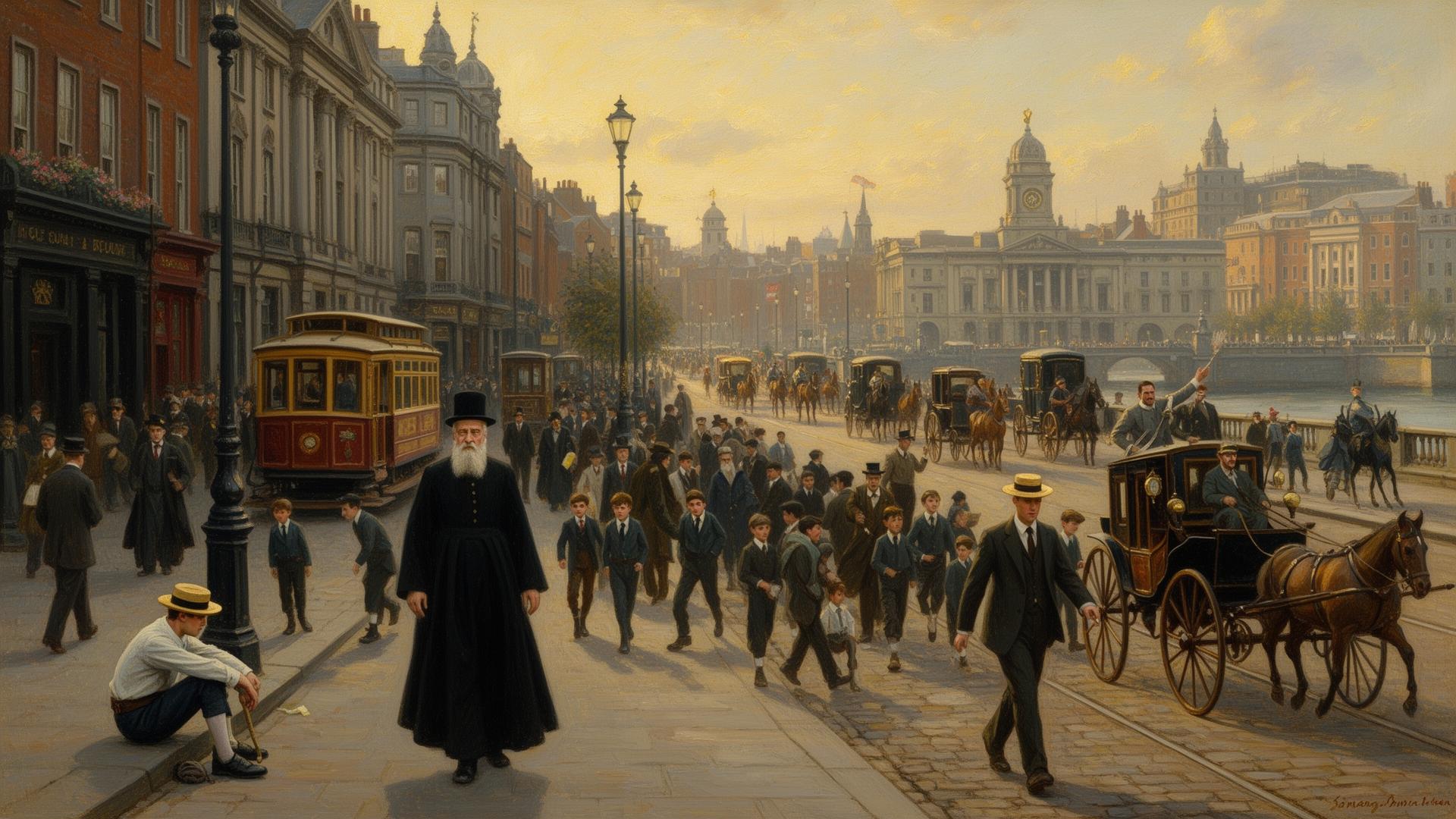
Painterly Edwardian Dublin street scene at 3 p.m.: trams, jaunting-cars, a black-soutaned priest, a one-legged sailor, schoolboys and the Viceregal cavalcade glimpsed in the distance — a labyrinth of citizens crossing paths.
Dublin Streets · Schedule · 3 p.m.
Itinerary — Nineteen Crossings
Conmee · the Sailor · Boylan · Dilly · Bookcart · the Cavalcade
Ep. X · 16 vi 1904
Episode X · Wandering Rocks · The City as Labyrinth

Wandering Rocks: Dublin in Nineteen Pieces.

Episode 10 of Ulysses takes the hazard Odysseus chose to avoid — Homer's clashing cliffs — and turns it into Dublin itself: nineteen short scenes of citizens at 3 p.m., framed by the Catholic Church walking north and the British Empire riding east, their paths almost meeting, almost crushing, and passing on.

"The superior, the very reverend John Conmee S.J. reset his smooth watch in his interior pocket as he came down the presbytery steps."
Ulysses, Episode 10 (opening)
F
Father Conmee
Church, walking north
T
The Viceroy
State, riding east
O
Odysseus
Avoids the rocks
T
The Planktai
Clashing cliffs
Plain-English mode
Scroll to begin
§1 · Why "Wandering Rocks"?

A hazard Odysseus skipped, a city Joyce mapped.

In Book 12 of the Odyssey, Circe describes two possible routes: the Wandering Rocks, a pair of clashing cliffs that grind ships to splinters, or the Strait of Scylla and Charybdis. Odysseus chooses the Strait. The Planktai are the hazard he does not face.

Joyce takes that absence and fills it with the whole city. Episode 10 has no hero — only nineteen short scenes of Dubliners moving through the streets at 3 p.m., framed by a priest walking north and a viceroy riding east, their paths interrupting and clashing with each other like the rocks themselves. Bloom appears in just one section, choosing a novel at a bookcart.

The clashing rocks become the streets of Dublin; the ship is everyone.

  1. c. 8th c. BCE
    Homer's Odyssey
    Circe warns Odysseus of the Planktai — he avoids them
  2. 1904
    Dublin under Dual Rule
    The Catholic Church and the British Crown share authority over the city
  3. 16 June 1904, ~3 p.m.
    Dublin streets
    Nineteen Dubliners criss-cross the city in a single hour
  4. 1918–19
    Drafted in Zurich
    Joyce composed the chapter with a Dublin map and a stopwatch
  5. 1922
    Publication
    Ulysses appears in Paris
§2 · Odyssey Primer

The Wandering Rocks in The Odyssey — in brief.

Circe tells Odysseus that after the Sirens he must choose between two routes. One leads through the Planktai, the Wandering Rocks — overhanging cliffs against which a dark sea endlessly crashes, and which grind any ship that tries to pass.

Not even birds can pass them safely: the doves that carry ambrosia to Zeus always lose one to the rocks, and Zeus sends in another to keep the number. Only the Argo has ever passed, and only because the goddess Hera loved Jason.

Odysseus chooses the other route — Scylla and Charybdis — and the Wandering Rocks remain a road not taken. Joyce takes precisely that gap, the chapter Homer skipped, and fills it with Dublin.

Rocks
Church
State
City
Clock
§3 · How Homer becomes Dublin

Six transformations, from the cliffs to the cavalcade.

Homer
The Planktai — cliffs that grind ships to splinters
Joyce
Dublin's streets, where lives almost collide

Homer's clashing rocks are a single binary peril: two cliffs, one ship, instant destruction. Joyce keeps the geometry and dissolves the scale — a whole city of small near-collisions: a priest's walk crossed by a sailor's crutch, a daughter's errand crossed by her father's drink, a viceroy's carriage crossed by every other plot in the book. The threat is no longer death; it is the slow attrition of being one of many.

Through the dark streets they hurried, past the rocks of dark stone.
Ulysses, Episode 10 (paraphrase of the closing cavalcade)
labyrinthcitymechanics
§4 · Who's Who

Homeric counterparts in Episode 10.

Wandering Rocks stages the whole city as the hazard — every Dubliner is a small ship trying to pass between Church and Empire.

UlyssesOdyssey counterpartNote
Father John Conmee S.J.One clashing rock — the ChurchOpens the chapter walking the city in a soutane on a charitable errand
The Viceregal cavalcadeThe other clashing rock — the StateCloses the chapter, retracing every previous section's location
Leopold BloomThe off-stage OdysseusAppears only at a bookstall — the hero deliberately demoted
Stephen DedalusThe off-stage TelemachusGlimpsed buying a book and meeting his sister Dilly
Blazes BoylanA doomed sailor in transitBuys flowers and fruit, flirts with the shop-girl, jaunting toward Molly
The one-legged sailorWreckage of a previous voyageBegs his way along the street; the chapter's recurring spliced figure
Dilly DedalusA child caught between rocksStands at a book-cart with her brother while her family starves
Tom Rochford & companyCitizens at their schemesDemonstrates a music-hall machine — the chapter's mechanical motif
Linati Schema (1920)

Scene: The Streets. Art: Mechanics. Symbol: Citizens. Technique: Labyrinth.

Gilbert Schema (1921)

Organ: blood. Colour: none. Hour: 3 p.m.

Homeric correspondences

Planktai → Church & State. Argo → Viceregal cavalcade. Doves → one-legged sailor.

§5 · Key themes

Ten threads through the hour of the city.

The city

Dublin itself is the protagonist; characters are pebbles.

Mechanics

Schema-art Mechanics; the chapter as a working machine.

Splices

Sentences from one section interrupt another mid-paragraph.

Church vs State

Conmee opens, the Viceroy closes — the two clashing rocks.

Near-miss

Dubliners pass each other without ever quite meeting.

Time

Every section is pinned to a precise hour and street.

Absence

Bloom appears in only one brief section — Joyce's structural joke.

Map

Joyce drafted the chapter with a real Dublin map and a stopwatch.

Power

The cavalcade is saluted, ignored, mocked — Empire glimpsed in passing.

Intermission

Joyce called it an 'entr'acte' — a pause from the interior monologue.

§6 · Quotations & close reading

Homer beside Joyce.

Homer

"On the one side are overhanging rocks, against which the great waves of dark-eyed Amphitrite crash with a mighty roar. The Blessed Gods call them the Wandering Rocks. Not even birds can pass them safely."

Odyssey, Book XII (Circe to Odysseus)

Joyce

"The superior, the very reverend John Conmee S.J. reset his smooth watch in his interior pocket as he came down the presbytery steps."

Ulysses, Episode 10 (opening line)

Why this matters

Circe's warning describes a place at the edge of the world; Joyce opens his chapter with a priest checking his watch on a presbytery step. The cosmic peril has been moved to the parish, and the time-keeping device that opens the chapter is its true theme.

Homer

"Through them not even winged things can pass safely, nor the timorous doves that bring ambrosia to father Zeus — even of these the sheer rock catches one each time, and the father sends in another to fill the number."

Odyssey, Book XII

Joyce

"A onelegged sailor crutched himself round MacConnell's corner, skirting Rabaiotti's icecream car, and jerked himself up Eccles street."

Ulysses, Episode 10 (the recurring sailor)

Why this matters

Homer's doves lose a feather between the rocks; Joyce's sailor has already lost a leg between earlier ones. The figure recurs across the chapter — every splice that returns to him is a reminder that some Dubliners have already been ground.

Homer

"Only one seafaring ship has ever passed through, that Argo famed of all, on her voyage from Aeetes; and even her the waves would have dashed against the great rocks, had not Hera sent her through for love of Jason."

Odyssey, Book XII

Joyce

"William Humble, earl of Dudley, and lady Dudley, accompanied by lieutenantcolonel Heseltine, drove out after luncheon from the viceregal lodge."

Ulysses, Episode 10 (the cavalcade)

Why this matters

Homer's one ship that passes is helped by a goddess; Joyce's cavalcade passes through the labyrinth helped by Empire. Both are exceptions to the rule — the everyday Dubliner is, by definition, not on the boat.

§7 · Modernity vs Epic

A road not taken, rewritten as a city block.

Homer

Cliffs, sea, doves

A pair of mythic rocks at the edge of the world, ground by a dark sea, lethal to ships and to birds. Odysseus is warned and chooses the other route. The peril is total and external.

Joyce

Trams, soutanes, schedules

A real Dublin afternoon at 3 p.m., with trams and jaunting-cars and a viceregal cavalcade, framed by the Church and the Empire. The peril is small, daily, and distributed across nineteen citizens — the slow grinding of being one of many.

Joyce takes the chapter Homer skipped and uses it to write the whole city — the labyrinth that no single hero can solve.

§8 · Why this episode matters

The structural fulcrum — and Joyce's portrait of the city.

Wandering Rocks is the tenth of eighteen chapters — the precise middle of the book. Joyce uses this midpoint to do something he does nowhere else: he pulls back from a single consciousness and shows the whole city moving at once. After this chapter, the novel returns to interior monologue with a new awareness of how small each mind is within the grid.

It is also the most generous chapter in Ulysses — the one where minor characters and walk-ons (Father Conmee, Dilly Dedalus, the one-legged sailor, the Dedalus girls boiling shirts in the kitchen) are given the same narrative dignity as Bloom and Stephen. The Homeric joke (avoid this chapter) becomes a quiet moral claim: every Dubliner is the hero of their own near-miss.

The hero steps back, the city steps forward, and for one hour the novel belongs to the strangers in the street.

§9 · FAQ

Quick answers.

  • Joyce names the chapter after a hazard Odysseus chooses NOT to face: the Planktai, the 'Wandering Rocks', a pair of clashing cliffs that grind ships to splinters. Circe describes them and tells Odysseus to avoid them entirely. Joyce takes the road not taken in Homer and turns it into Dublin itself — nineteen short sections of citizens moving through the streets at the same hour, their paths almost colliding, almost connecting, the whole city briefly visible as a machine of near-misses.