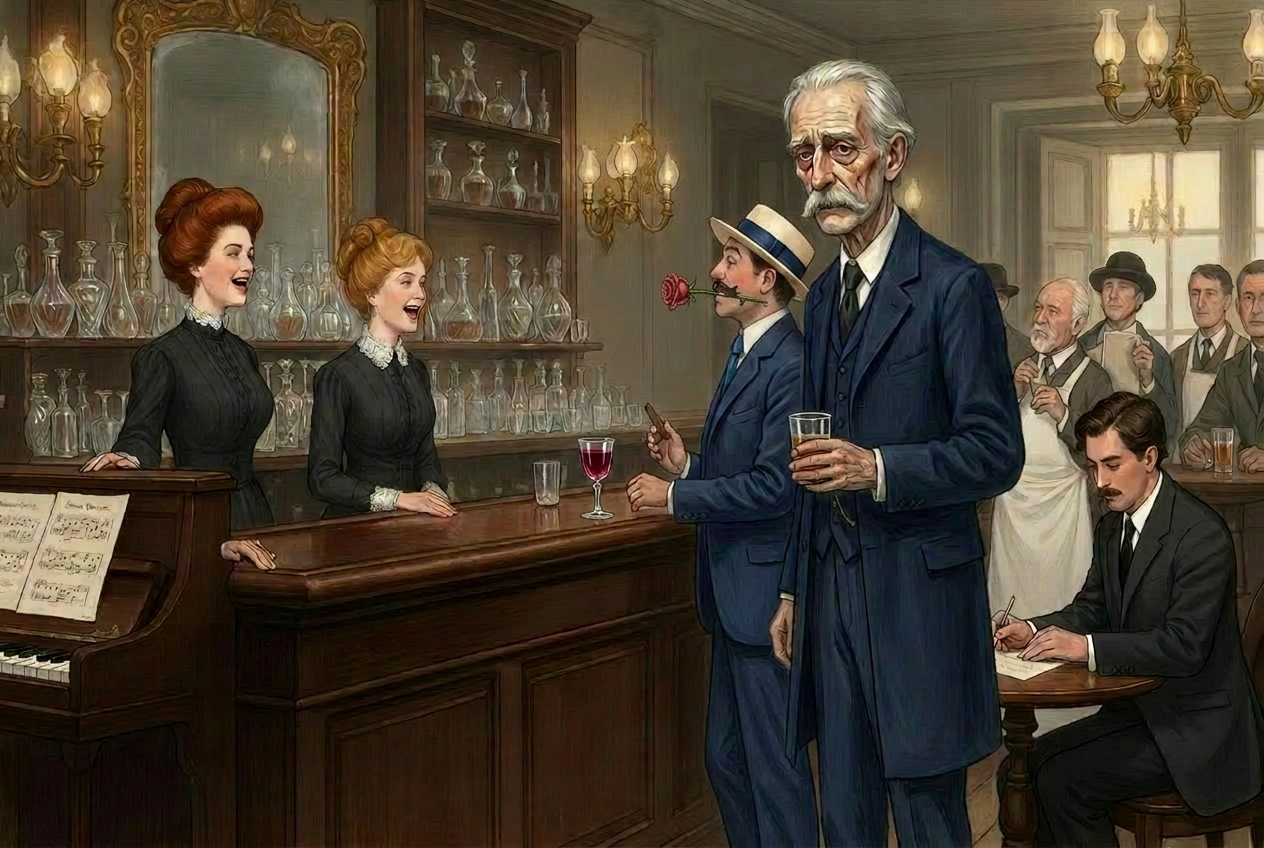
Painterly Edwardian interior of the Ormond Hotel bar in Dublin: a bronze-haired and a gold-haired barmaid lean across a polished mahogany counter, a man plays an upright piano, Leopold Bloom sits writing alone at a side table, the silhouettes of two sirens woven into cigar-smoke above the room.
Ormond Hotel · Bar & Restaurant · 4 p.m.
Programme — Music for the Afternoon
M'appari · The Croppy Boy · Love's Old Sweet Song
Ep. XI · 16 vi 1904
Episode XI · Sirens · Music & the Hour of Adultery

Sirens: Bloom Lashed to the Mast.

Episode 11 of Ulysses moves Homer's singing temptresses into the bronze-and-gold bar of the Ormond Hotel — and surrounds Bloom with every modern Siren (song, drink, sentiment, a jingling jaunting-car bound for Eccles Street) at the precise hour his wife meets her lover.

"Bronze by gold heard the hoofirons, steelyringing."
Ulysses, Episode 11 (opening)
L
Leopold Bloom
Hearing, not drowning
D
Douce & Kennedy
Bronze and gold barmaids
O
Odysseus
Bound to the mast
T
The Sirens
Singing on the isle
Plain-English mode
Scroll to begin
§1 · Why "Sirens"?

A hotel bar, two barmaids, a fugue.

In Book 12 of the Odyssey, Circe warns Odysseus of an island where singing women lure sailors onto rocks. He plugs his crew's ears with wax, has himself bound to the mast, and sails past hearing every note without consenting to die for it.

Joyce relocates the strait to the bar of the Ormond Hotel on the north Dublin quays. The Sirens are Miss Douce and Miss Kennedy; the song is opera, ballad and barmaid-flirtation; the appointed hour is 4 p.m. — and at exactly that hour, in a bed across the city, Molly Bloom is unfaithful. Bloom sits, hears it all, and binds himself to a quiet act of letter-writing.

The Homeric mast becomes a side-table in a dining room.

  1. c. 8th c. BCE
    Homer's Odyssey
    Odysseus is lashed to the mast past the Sirens
  2. 1847
    Flotow's Martha
    The opera whose tenor aria becomes the chapter's Siren-song
  3. 1798
    The Croppy Boy
    The ballad sung by Ben Dollard — the chapter's second song
  4. 16 June 1904, ~4 p.m.
    Ormond Hotel, Ormond Quay
    Bloom hears, writes, endures; Boylan jingles past
  5. 1922
    Publication
    Ulysses appears in Paris
§2 · Odyssey Primer

The Sirens in The Odyssey — in brief.

Circe tells Odysseus that as he leaves her island he will come first to the Sirens, whose singing bewitches all men who hear it. The shore around them is white with the bleached bones of sailors who steered toward the voice.

The instructions are precise: stop your crew's ears with softened beeswax. If you wish to hear the song yourself, have the men bind you upright to the mast and, no matter how you beg, refuse to untie you until the island is well behind you.

Odysseus obeys. He hears the song — and survives only because of the discipline of the rope. Joyce takes this minute of bound, attentive hearing as the template for his whole musical chapter.

Song
Bronze
Gold
Mast
Tap
§3 · How Homer becomes Dublin

Six transformations, from the island to the Ormond.

Homer
Two singing Sirens on their island
Joyce
Miss Douce and Miss Kennedy at the Ormond bar

In the Odyssey the Sirens are two (later traditions multiplied them) — voices alone, with no flesh worth describing. Joyce's two barmaids are all flesh: a colour, a laugh, a snapping garter, a heave of a sigh. The disembodied voice that wrecks ships has been re-incarnated as Edwardian Dublin charm — and is, by design, much harder to resist.

Bronze by gold heard the hoofirons, steelyringing.
Ulysses, Episode 11 (opening)
barmaidscolouroverture
§4 · Who's Who

Homeric counterparts in Episode 11.

Sirens stages the Ormond Hotel as Homer's singing island — a single room full of voices, each promising to undo the listener in a different way.

UlyssesOdyssey counterpartNote
Leopold BloomOdysseus at the mastHears all the songs of Dublin without being undone
Miss Lydia DouceSiren (bronze)Snaps her garter, embodies the chapter's flesh-music
Miss Mina KennedySiren (gold)Quieter, gold-haired, fixes the listener with a stare
Simon DedalusThe chief singerHis tenor voice in M'appari is the chapter's high temptation
Ben DollardThe bass singerBellows The Croppy Boy — patriotic Siren-music
Blazes BoylanA doomed sailor (un-bound)Jingles past the bar bound for Molly — sails straight at the rocks
Pat the bald waiterThe deafened crewmanCannot hear properly; serves the food while the song goes on
Linati Schema (1920)

Scene: The Concert Room. Art: Music. Symbol: Barmaids. Technique: fuga per canonem.

Gilbert Schema (1921)

Organ: ear. Colour: none. Hour: 4 p.m.

Homeric correspondences

Sirens → Douce & Kennedy / the songs themselves. Mast → Bloom's side-table.

§5 · Key themes

Ten threads through the hour of music.

Music

Schema-art Music; the prose performs a fugue per canonem.

Temptation

Sentiment, drink, female attention — the modern Siren-songs.

The body

Bronze hair, snapped garters, beer-foam — flesh as music.

Boylan & 4 p.m.

The chapter coincides with the appointed hour of the adultery.

Restraint

Bloom's letter-writing is the chapter's quietest heroism.

Patriotism

The Croppy Boy and national sentiment as Siren-song.

Anti-epic

The hero's escape sounds — literally — like a fart.

Memory

Bloom's mind ranges over Molly, Rudy, Milly while music plays.

Language

The chapter's deepest Siren is its own seductive style.

Tap, tap, tap

The blind piano-tuner's cane: a counter-rhythm to the song.

§6 · Quotations & close reading

Homer beside Joyce.

Homer

"First you will come to the Sirens, who bewitch all men that approach them. … There is no homecoming for the man who draws near them unawares and hears the Sirens' voices."

Odyssey, Book XII (Circe to Odysseus)

Joyce

"Bronze by gold heard the hoofirons, steelyringing. Imperthnthn thnthnthn."

Ulysses, Episode 11 (overture)

Why this matters

Homer's warning is a sober speech; Joyce's warning is a fragmented sound-cluster. The chapter is announcing, from its first words, that meaning will arrive as music before it arrives as sense.

Homer

"Bind me with a hard bond, that I may stay there in my place, upright in the mast-step, and let the ropes' ends be fastened to the mast itself."

Odyssey, Book XII (Odysseus' instructions)

Joyce

"Bloom unwound slowly the elastic band of his packet. … Wrote on. … Sad. Bored."

Ulysses, Episode 11

Why this matters

Odysseus' ropes become Bloom's elastic band; the hero's mast becomes a side-table in a dining room. Joyce keeps the gesture (a small physical act of binding oneself to the present) and changes its scale to the domestic.

Homer

"But when the men's eager rowing had brought the well-built ship within hail, they raised their loud song."

Odyssey, Book XII

Joyce

"—When first I saw that form endearing… Sorrow from me seemed to depart."

Ulysses, Episode 11 (Simon Dedalus singing M'appari)

Why this matters

The Homeric Siren-song is unrepresentable — Homer only reports its effect. Joyce gives us the song itself, in Italian opera and English ballad, and asks the reader to do what Odysseus does: hear it, feel it, and refuse to sink.

§7 · Modernity vs Epic

A divine voice, rewritten as a hotel bar.

Homer

Divine song, ship and rope

A demigod hero is bound to a wooden mast and hears an otherworldly voice promising perfect knowledge. The temptation is metaphysical, and the survival is physical (the rope holds).

Joyce

Pub song, side-table and pen

A modern man sits in a hotel dining room and hears very ordinary songs about lost love while his wife is unfaithful across town. The temptation is sentiment, and the survival is moral (he keeps writing).

Joyce keeps the act of bound, attentive hearing and changes everything else — the wax in the ears becomes a pen on a page.

§8 · Why this episode matters

The novel's most musical hour — and Bloom's quietest victory.

Sirens is the chapter in which Joyce most openly puts style on the page as a temptation. The opening overture, the alliterative trills, the broken words pretending to be grace-notes — these are written to seduce the reader, exactly as the songs in the room seduce the drinkers. To read the chapter is to be the man at the mast.

And while the prose sings, the plot is brutally simple. At 4 p.m. Molly meets Boylan; at 4 p.m. Bloom sits writing a letter to another woman he will never meet, and refuses to break. The novel's whole moral case for Bloom is made in this hour of held composure.

The wax in the ears becomes a pen on the page; the rope becomes a quiet refusal to drink another whiskey.

§9 · FAQ

Quick answers.

  • Joyce maps Episode 11 onto Book 12 of the Odyssey, where Odysseus sails past the Sirens — singing women whose voices lure sailors to their deaths. Joyce calls his chapter 'Sirens' because the bronze and gold barmaids of the Ormond Hotel bar, the singing of patriotic ballads at the piano, and the seductive music of language itself all combine to threaten Bloom with the most modern of shipwrecks: distraction, sentimentality, and the knowledge that, at this very moment across town, his wife is meeting her lover.