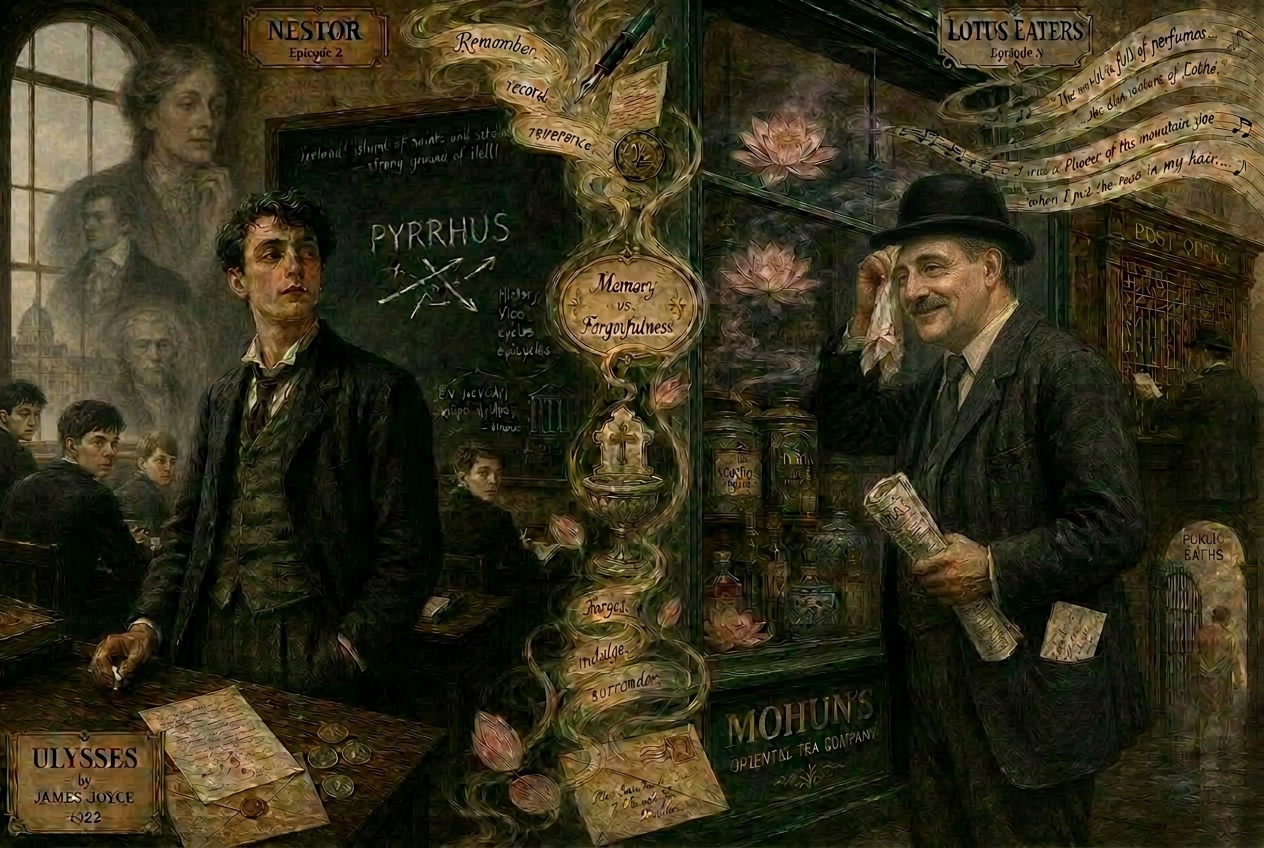
History vs Forgetfulness.
A tale of two chapters: one trapped in the nightmare of history, the other adrift in narcotic daydreams.
"History is a nightmare from which I am trying to awake."Stephen Dedalus · Ulysses, Episode 2
Remembering and forgetting.
In Episode 2: Nestor, Stephen Dedalus teaches a class in Dalkey only to rebuke his headmaster with the famous line that history is "a nightmare from which I am trying to awake." A few hours later, in Episode 5: Lotus Eaters, Leopold Bloom strolls through Dublin, succumbing to distractions and reveries like Odysseus's men who tasted the lotus and forgot their mission.
Read side by side, the two chapters mirror and oppose one another through escape, memory and desire. Stephen carries the burden of the past; Bloom yields to the seduction of oblivion. This pairing sets remembrance against narcotic drift — two ways of meeting a single Dublin morning.
Two answering chapters
Click any row to read how Nestor and Lotus Eaters respond to one another.
Nestor is the chapter of history and remembrance; Lotus Eaters is the chapter of drift and oblivion. One man cannot escape the past, the other gently mislays the present.
Two forms of escape
Both men long to slip the leash of the morning — but they flee in opposite directions.
Stephen seeks intellectual escape. He out-argues Mr Deasy, deflects the weight of his teaching post, and reaches past family, nation and the dead toward a freedom of thought. His flight is upward, into idea and irony.
Bloom seeks sensory escape. He drifts among perfumes and shop windows, savours a flirtatious letter, anticipates the warm bath, and lets his attention dissolve into pleasant distraction. His flight is downward, into the body and its comforts.
Memory vs forgetfulness.
Stephen cannot stop remembering; Bloom would rather not. Joyce sets the nightmare of history against the lotus that makes the crew "forget their mission" — and lets the two states define one another.
History presses on Stephen like a bad dream he is straining to wake from. Memory is a burden — the dead mother, the failed past, Deasy's complacent providence.
"History is a nightmare from which I am trying to awake."
Bloom lets the morning blur into reverie. Like the lotus-eaters, he is gently unmoored from purpose — content to wander, sniff, read and dream rather than act.
The lotus makes the crew "forget their mission" and lose the wish to return home.
Money & messages
Both episodes close on small economic and epistolary acts — letters change hands, coins and adverts are weighed.
Stephen receives his teaching wages and is handed Mr Deasy's self-important letter on foot-and-mouth disease to carry to the newspapers. The chapter ends in money counted and a message entrusted.
Bloom collects Martha Clifford's flirtatious letter under the name 'Henry Flower', and his mind turns over advertisements and small sums. The morning runs on secret correspondence and commerce.
Desire & fertility
From the public life of the herd to the private life of the flesh — the two chapters trade in different orders of generation.
Nestor's imagery is communal and historical: cattle and foot-and-mouth disease, the breeding of the nation, the great public goal of history. Fertility here is a matter of livestock and lineage.
Lotus Eaters turns inward to the body — perfume, warmth, the languid bath, and Bloom's musings on marriage, reproduction and desire. Fertility here is intimate, sensuous and quietly troubled.
Water & reverie.
Tides, baths and holy water ripple through both chapters. Stephen's mind drifts toward drowning and the sea of the past; Bloom moves toward the warm, womb-like bath that ends his morning. Each episode is suffused with mental wandering — a current carrying its hero away from the hard ground of action.
"Two streams of consciousness, one flowing back into memory, the other dissolving into dream."
Homeric origins
The pairing reaches back to two opposed moments of the Odyssey.
In the Odyssey, old Nestor of Pylos receives Telemachus and pours out the long memory of the war and its heroes. He is the rememberer — the voice that preserves the past so it will not be lost.
The lotus-eaters embody forgetting. Odysseus's men taste the plant, lose all longing for home, and must be hauled back to the ships. They are memory's opposite — sweet, dangerous oblivion.
Placed together, the two sources underscore Joyce's great theme: the play between remembering and forgetting. Nestor preserves; the lotus dissolves. Stephen and Bloom live out that opposition across a single Dublin morning.
The burden and the balm.
Nestor and Lotus Eaters give us the two great temptations of the mind: to be ruled by memory, or to be released from it. Stephen cannot wake from history; Bloom would rather drowse through it. Held together, they map the emotional weather of the whole novel — the pull between what we must remember and what we long to forget.
Frequently asked
Episode 2 (Nestor) and Episode 5 (Lotus Eaters) form a quiet contrast at the heart of Joyce's morning. Nestor is steeped in memory — Stephen Dedalus teaches a history lesson and famously calls history "a nightmare from which I am trying to awake." Lotus Eaters is steeped in forgetfulness — Bloom drifts through Dublin among perfumes, daydreams and small temptations, like Odysseus's men who tasted the lotus and forgot the way home. Together they stage the novel's tug-of-war between remembering and oblivion.