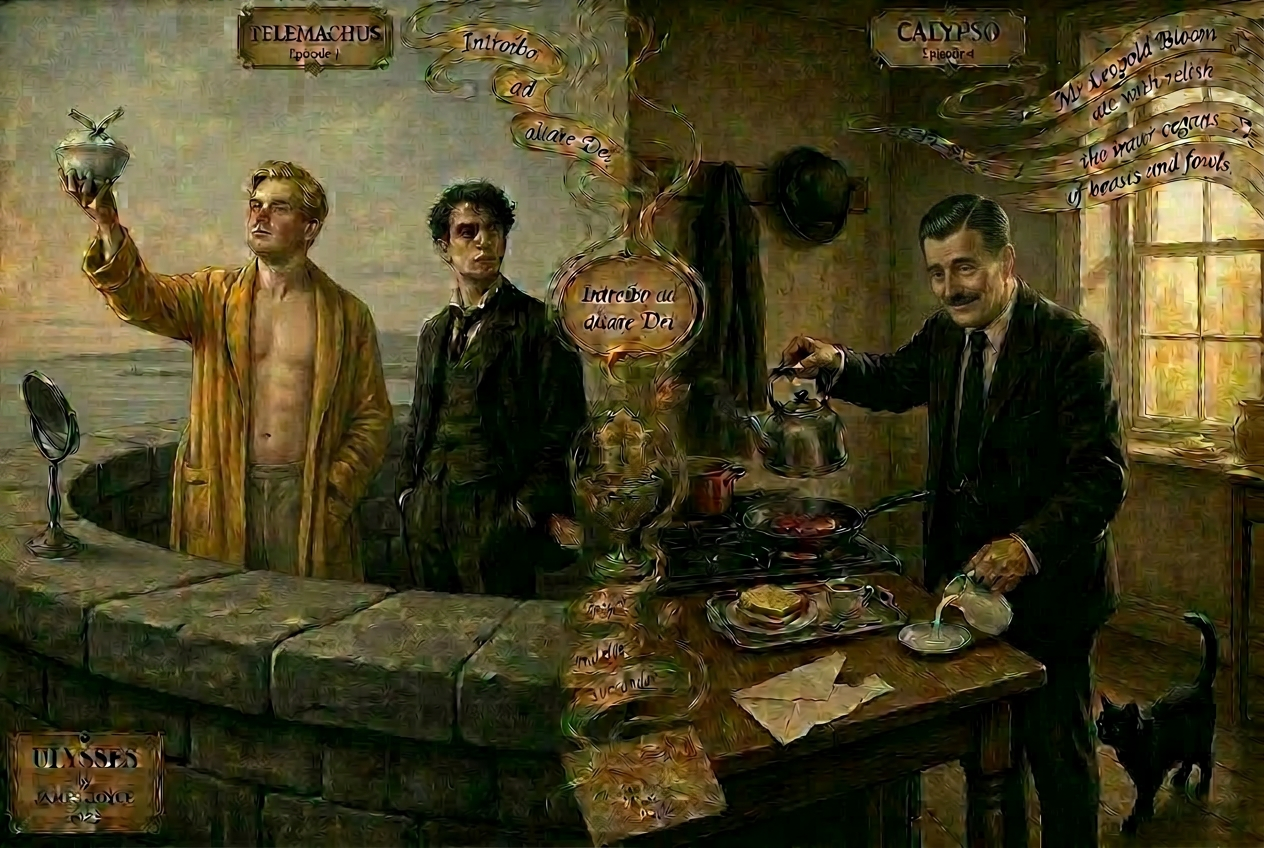
Split-screen illustration: Stephen Dedalus atop the Martello Tower in a suit and tie, holding his ashplant walking stick and a small key at dawn; a young Leopold Bloom standing by the weathered Georgian door of 7 Eccles Street with the cat under the same morning sun.
Episode I · Telemachus  ✦  Episode IV · Calypso

Telemachus & Calypso: Mirror Chapters in Ulysses.

After three episodes inside Stephen Dedalus's world, Joyce rewinds the clock and introduces Leopold Bloom in a chapter that mirrors the themes, symbols and emotional conflicts of the opening. Two men. Two homes. Two exiles.

"Joyce creates two parallel mornings, two parallel exiles, and two parallel journeys that will ultimately converge."
Two Men
Stephen · Bloom
Two Homes
Tower · House
Two Exiles
Son · Father
Scroll to begin
Introduction

Two beginnings, one design.

Many Joyce scholars regard Episode 1: Telemachus and Episode 4: Calypso as deliberate structural reflections of one another. They are the twin doorways of the novel — one opening on a young artist, the other on an ordinary man.

After spending the first three episodes — the Telemachiad — inside Stephen's restless mind, Joyce does something audacious: he rewinds the narrative clock to the same early morning and starts again with Leopold Bloom. The second beginning quietly repeats the first, theme for theme and symbol for symbol.

Read side by side, the chapters reveal a single architecture. Stephen lacks a father; Bloom lacks a son. The whole emotional structure of Ulysses grows out of those corresponding voids.
§1 · Structure

The great mirror structure

Telemachus and Calypso both begin around 8 a.m. on 16 June 1904 and serve as introductions to the novel's two protagonists. Episodes 2 and 3 carry Stephen through his morning — then Joyce resets the clock, and Bloom lives the very same hours across the city.

Same hour08:00
Episode I08:00
Stephen Dedalus
The Martello Tower, Sandycove

Shaving on the gun-platform with Mulligan and Haines; the day, and the novel, begin.

Episode IV08:00
Leopold Bloom
7 Eccles Street, north Dublin

Feeding the cat and preparing Molly's breakfast as the clock is wound back to the same morning.

Joyce rewinds the narrative clock
§2 · Comparison

Parallel lives

Click any row to read how the two episodes answer one another.

I · Telemachus — Stephen
IV · Calypso — Bloom

The shared term. Both men are surrounded by others yet profoundly alone — Stephen among mockers, Bloom inside a marriage about to be betrayed.

§3 · Displacement

The usurpers.

Both heroes are pushed to the weakest position in their own homes. Stephen is crowded out of the Tower; Bloom's marriage is quietly invaded. Displacement is the engine of both mornings.

Stephen
  • Buck Mulligan occupies the Tower
  • Haines is an unwelcome English guest
  • Stephen no longer feels at home
Bloom
  • Boylan threatens Bloom's marriage
  • Molly's affair looms over the household
  • Bloom no longer feels secure in his home
Each protagonist occupies the weakest position
Stephen
Mulligan
Haines
Bloom
Molly
Boylan
§4 · Symbolism

Keys & exile

Locked Out

Stephen hands over the key

At the close of Telemachus, Stephen gives Mulligan the great key of the Martello Tower he himself pays rent on. The gesture is a surrender of home — he will not sleep there again.

"I will not sleep here tonight. Home also I cannot go."
Ulysses, Episode 1

Bloom forgets his key

On his own doorstep Bloom feels for the latchkey and finds it missing — left in the trousers he changed out of. He steps into the day locked, gently, out of number 7.

"On the doorstep he felt in his hip pocket for the latchkey. Not there."
Ulysses, Episode 4

Scholars often interpret both keys as symbols of belonging, ownership and exclusion. One man gives his away; the other simply forgets his — but each leaves home a little dispossessed, a stranger at his own door.

§5 · The everyday

Breakfast & domestic ritual

Joyce uses ordinary morning routines to reveal character — resentment in one house, tenderness in the other.

Stephen's morning
  • 01The milkwoman arrives at the Tower
  • 02Breakfast is made for Haines
  • 03Tension, debt and resentment simmer
Bloom's morning
  • 01He feeds the cat — Mkgnao
  • 02He buys a pork kidney from Dlugacz
  • 03He prepares Molly's breakfast tray
§6 · Grief

Mourning & loss.

Both men wear black, and both carry a death. Joyce sets one grief against the other — a son mourning a mother, a father mourning a son.

Stephen's loss
His mother
  • Guilt
  • Refusal to pray at her bedside
  • The ghostly visitation
🪑facing🪑
Bloom's loss
Rudy
  • Tender memories
  • Lost fatherhood
  • An emotional absence
§7 · Symbol explorer

Mother & milk

A single image — milk — that Joyce echoes deliberately across both mornings. Hover or tap a side to explore.

🥛Milk
Telemachus
Episode I
The old milkwomanMother IrelandNourishmentTradition
Calypso
Episode IV
Bloom's milk purchaseDomestic lifeCaregivingEveryday sustenance

The milkwoman who climbs to the Tower and the milk in Bloom's kitchen rhyme across the novel — nourishment, mother, tradition and care poured into two very different households.

§8 · The Odyssey

Homeric parallels

Joyce maps his two openings onto opposite ends of Homer's poem — the waiting son and the trapped father.

Episode I · Telemachus
Homeric counterpart
Telemachus
  • The son
  • Seeking identity
  • Waiting for Odysseus
Stephen → Telemachus
Episode IV · Calypso
Homeric counterpart
Odysseus
  • The father
  • Trapped at home
  • Awaiting reunion
Bloom → Odysseus
§9 · Estrangement

A tale of two exiles

Each man is exiled from different things — but the centre they share is the same.

Stephen's exile
  • Church
  • Family
  • Ireland
  • Home
Shared centre
  • Isolation
  • Loneliness
  • Search for connection
Bloom's exile
  • Marriage
  • Religion
  • Society
  • National identity
§10 · Convergence

The road to encounter.

Two routes leave two homes and bend, slowly, toward the same point. Joyce keeps Bloom and Stephen apart for most of the day so their late meeting can feel inevitable.

Martello Tower
Son seeking a father
Dublin
7 Eccles Street
Father seeking a son
Routes converge toward the later encounters of Bloom & Stephen
§11 · Criticism

Scholar perspectives

How leading critics read the mirror relationship between Episodes 1 and 4.

Summaries paraphrase verifiable scholarly viewpoints; no quotations are invented.

§12 · Criticism · For the Eagle Eyed

Hidden mirror motifs

Four small details Joyce plants in both chapters. Hover (or tap) each card to see how the tower's image answers Eccles Street.

Black Cats

Telemachus
The Panther

Haines cries out in his sleep about shooting a black panther — a predatory, nightmarish creature prowling the tower's darkness.

Calypso
“the pussens”

Bloom's morning opens with the household cat, addressed tenderly as “the pussens.” The wild, hunted panther answers the soft domestic cat.

Burnt Offerings

Telemachus
Breakfast

Mulligan's mock-Mass turns the tower's fry-up into a parody of sacrifice — the morning meal staged as ritual offering.

Calypso
Kidneys

Bloom lets his grilled kidney singe and scorch — “a faint scorch of singeing” — food cooked with an almost sacrificial smell.

White Teeth

Telemachus
Mulligan's

Buck Mulligan grins with gleaming white teeth as he mocks and dominates — the usurper's predatory smile.

Calypso
The Cat's

The cat shows its small sharp white teeth as it laps and mews — predatory whiteness mirrored between human usurper and animal.

Green Stones

Telemachus
Cigarette Case

Mulligan's smooth green stone cigarette case glints in the tower light — a cool, jewel-like green object of vanity.

Calypso
Cat's Eyes

The cat fixes Bloom with green flashing eyes — the same uncanny green glint answered across the two mornings.

Why the mirror matters

Two complementary absences.

Joyce's greatest achievement here is not simply creating two protagonists, but creating two answering voids. Stephen lacks a father. Bloom lacks a son. The entire emotional architecture of Ulysses grows from those corresponding absences.

Stephen
lacks a father
Bloom
lacks a son
Stephen
walking east →
Dublin
Bloom
← walking west
"Before they meet, Joyce teaches us that they are already reflections of one another."
· Questions

Frequently asked

Both episodes open around 8 a.m. on 16 June 1904 and introduce a protagonist in his contested home. Joyce rewinds the narrative clock after three Stephen-centred episodes to begin again with Bloom, repeating themes of exile, usurpation, keys, breakfast, mourning and milk. The deliberate symmetry invites readers to see Stephen and Bloom as reflections of one another long before they meet.