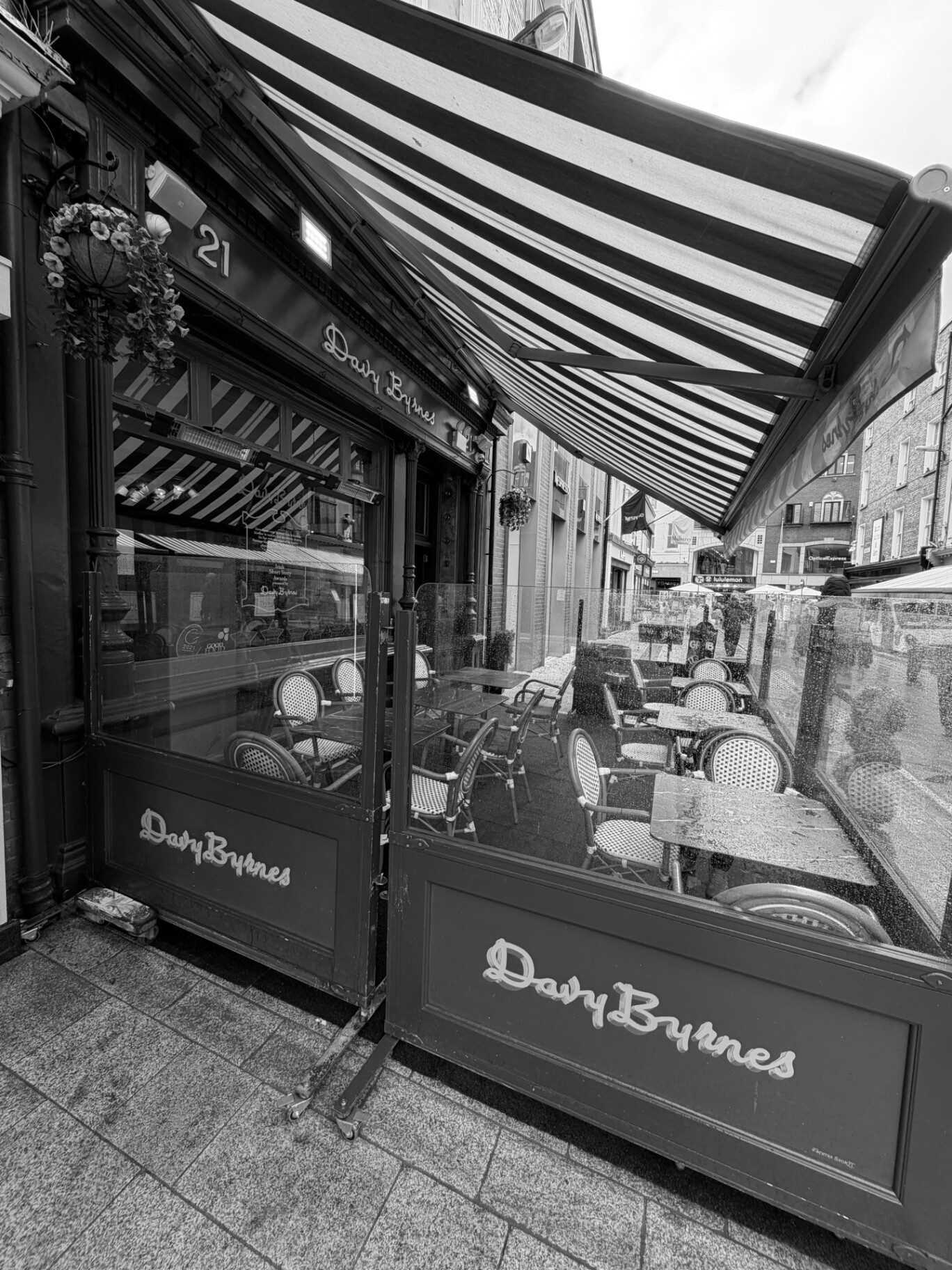
Interior of Davy Byrne's pub, Dublin, 1pm on 16 June 1904: Leopold Bloom in a bowler hat eats a quiet gorgonzola sandwich with a glass of burgundy while red-faced men devour plates of meat at the bar — Joyce's modern Lestrygonians.
Davy Byrne's · Bill of Fare · 1 p.m.
  • Gorgonzola sandwich7d
  • Glass of burgundy6d
  • (Burton men, declined)
Episode VIII · Lestrygonians · Hunger & Restraint

Lestrygonians: Dublin Eats Itself.

Episode 8 of Ulysses turns Homer's harbour of cannibal giants into a Dublin lunch hour — and finds the modern hero in a man eating a cheese sandwich, slowly, by himself.

"See the animals feed. Men, men, men."
Ulysses, Episode 8
L
Leopold Bloom
Hungry, watchful
T
The Burton men
Wolfing their lunch
O
Odysseus
Sole surviving captain
A
Antiphates
Cannibal king
Plain-English mode
Scroll to begin
§1 · Why "Lestrygonians"?

A harbour of cannibals, replanted in Dawson Street.

In Book 10 of the Odyssey, Odysseus' fleet rows into the sheltered harbour of Telepylus, home of the Lestrygonians, a race of cannibal giants. Only Odysseus, having moored his own ship outside the cove, escapes. Eleven of his twelve ships are destroyed; his men are speared and carried away as food.

Joyce moves the cannibals indoors. The harbour is the Burton restaurant, packed at lunchtime with men wolfing chops and stuffing their mouths. Bloom, like Odysseus, has the survival sense to step back out — and chooses, instead, a quiet pub and a small meal. The Homeric epic of devouring becomes a small domestic ethics.

How you eat is who you are.

  1. c. 8th c. BCE
    Homer's Odyssey
    The Lestrygonians destroy 11 of Odysseus' 12 ships
  2. 1840s
    Dublin pub culture matures
    Davy Byrne's licensed; lunchtime drinking the norm
  3. 1880s
    Burton-style restaurants spread
    Cheap chop-houses for working Dublin
  4. 16 June 1904, 1 p.m.
    Lunch hour
    Bloom from O'Connell Bridge to Duke Street
  5. 1922
    Publication
    Ulysses appears in Paris
§2 · Odyssey Primer

Lestrygonians in The Odyssey — in brief.

Blown back from Aeolia, Odysseus' fleet reaches the land of the Lestrygonians, a race of huge, cannibal people. Eleven of his twelve ships row into a deep, narrow harbour. He alone moors his ship outside.

His scouts meet the giant daughter of the king Antiphates, who leads them home. Her father seizes one of the men and eats him on the spot; the rest of the giants rush to the cliffs, hurling boulders down onto the trapped ships and spearing the men in the water like fish.

Only Odysseus' single ship escapes. Book 10 is the Odyssey's starkest lesson in foresight and the human cost of hospitality misread — and Joyce takes it as the template for a single hour of Dublin's appetite.

Bread
Wine
Knife
Throat
Coin
§3 · How Homer becomes Dublin

Six transformations, from Telepylus to Duke Street.

Homer
Odysseus scouting the Lestrygonian harbour
Joyce
Bloom walking from O'Connell Bridge to Duke Street

Odysseus sails his fleet into a quiet-looking harbour and is the only captain prudent enough to moor outside it. Bloom, equally prudent, drifts through hungry Dublin and is the only diner sensitive enough to back out of the Burton. The Homeric scout becomes a man with a sandwich problem — but with the same instinct for survival.

—I was just going to throw it away, Mr Bloom said. He led him out of the noise into the gloom of the arcade.
Ulysses, Episode 8
walkingrestraintBloom
§4 · Who's Who

Homeric counterparts in Episode 8.

Lestrygonians stages Dublin's lunch hour as a Homeric harbour — and turns the choice of where to eat into a moral test.

UlyssesOdyssey counterpartNote
Leopold BloomOdysseus the prudent scoutSurvives by foresight: moors outside the harbour, leaves the Burton
The Burton dinersThe Lestrygonian giantsHospitality become predation
Blazes Boylan (glimpsed)Antiphates, the predator kingThe cannibal who will eat Bloom's marriage at 4 p.m.
Davy Byrne's pubThe sheltered coveThe one safe harbour of the chapter
The gorgonzola sandwichOdysseus' temperate rationBloom's ethical refusal of the cannibal feast
The blind striplingThe lost crewmanJoyce inverts the loss into an act of rescue
Linati Schema (1920)

Scene: The Lunch. Art: Architecture. Symbol: bloody sacrifice / food.

Gilbert Schema (1921)

Organ: oesophagus. Technique: peristaltic. Colour: none specified.

Homeric correspondences

Antiphates → Boylan. Lestrygonians → Burton men. Single prudent ship → Bloom in Davy Byrne's.

§5 · Key themes

Ten threads through the lunch hour.

Hunger

The chapter's engine — physical, social, sexual, all unsatisfied.

Digestion

The technique is peristaltic: thoughts swallowed, churned, dropped.

Disgust

Bloom's recoil from the Burton: an ethics built on the gag reflex.

The body

Organ: oesophagus. Bowels, gristle, gravy, sweat — the chapter's flesh.

Boylan

The 4 p.m. appointment haunts every street and every shop window.

Charity

Bloom helping the blind stripling: heroism redefined as care.

Vegetarianism

Joyce flirts with meat-refusal: the moral high ground tastes of cheese.

Marriage

Bloom remembers the Howth seedcake — the chapter's lyrical centre.

Dublin

Streets, statues, shop windows: lunchtime as a precise map.

Time

1 p.m. — the chapter measured by appointments and church bells.

§6 · Quotations & close reading

Homer beside Joyce.

Homer

"Forthwith they speared them like fishes and bore them home, a loathly meal."

Odyssey, Book X (public domain trans.)

Joyce

"See the animals feed. Men, men, men. … Eat or be eaten. Kill! Kill!"

Ulysses, Episode 8

Why this matters

Homer's literal cannibalism is internalised as Bloom's silent judgement on the Burton. Joyce keeps the Homeric horror and translates it into the interior gag of a watching man.

Homer

"There no man who could go without sleep might earn a double wage… for the paths of night and day are close."

Odyssey, Book X (the Lestrygonian land)

Joyce

"Two and three. Bob and a tanner. Bob and a tanner. Time to be shifting. Lestrygonians."

Ulysses, Episode 8

Why this matters

Homer's strange land of no sleep becomes Bloom's lunch-hour arithmetic of coins. The exotic geography is replaced by the small economies of survival.

Homer

"Alone, I made fast my dark-prowed ship outside the harbour at the uttermost point."

Odyssey, Book X

Joyce

"Get out of this. Try Davy Byrne's. Moral pub. He doesn't chat. Stands a drink now and then."

Ulysses, Episode 8

Why this matters

Odysseus' single prudent mooring becomes Bloom's single prudent pub. The same instinct — stay outside the swallowing harbour — saves both heroes.

§7 · Modernity vs Epic

Cannibal harbour, rewritten as restaurant.

Homer

Literal cannibals

Giants seize men out of the water and eat them. Death is sudden, collective, and entirely physical.

Joyce

Social cannibals

Diners shovel chops into their mouths while Boylan, blocks away, prepares to eat Bloom's marriage. The horror is mannered, invisible, and entirely modern.

Joyce keeps the appetite and changes its object — the gods have been replaced by lunch.

§8 · Why this episode matters

The chapter where Bloom becomes our hero.

Lestrygonians is the chapter that earns Bloom the title of the novel's ethical centre. Faced with the cannibal city, he chooses small kindness: a quiet pub, a slow sandwich, and guiding a blind man across the road.

It is also the chapter of the seedcake memory on Howth — the novel's most tender flashback, a marriage proposal renewed in the middle of a hungry afternoon. Bloom survives the Lestrygonians not by anger but by memory and care.

The modern hero is not the man with the sword. He is the man who notices the blind stripling.

§9 · FAQ

Quick answers.

  • Joyce maps Episode 8 onto Book 10 of the Odyssey, where Odysseus's fleet is attacked by the Lestrygonians, a race of cannibal giants who hurl boulders and eat his men. Joyce calls his chapter 'Lestrygonians' because it is lunchtime in Dublin: the streets and pubs are full of men eating — and the way they eat, gobbling and stuffing, makes Bloom recoil as if he had stumbled into a den of giants.