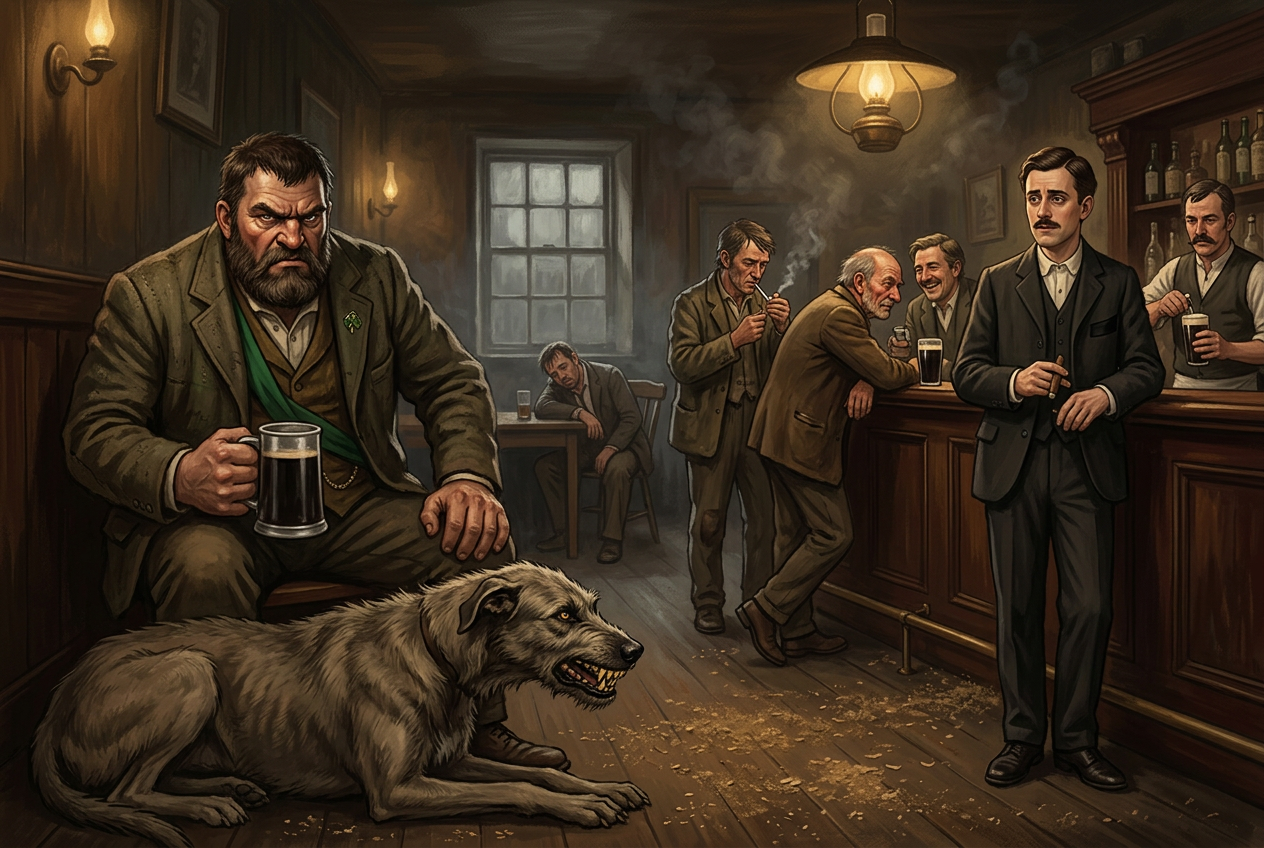
Painterly interior of Barney Kiernan's Dublin pub: a huge bearded one-eyed nationalist in a green coat looms at a table with a mangy dog at his feet, raising a biscuit-tin; Leopold Bloom stands at the doorway in profile, dignified; a faint ghostly Cyclops silhouette woven into the smoke behind.
Barney Kiernan's · Little Britain Street · 5 p.m.
Item: One empty Jacob's biscuit-tin.
Velocity: hurled. Trajectory: poor. Target: a Jewman.
Ep. XII · 16 vi 1904
Episode XII · Cyclops · Nationalism & One-Eyed Vision

Cyclops: A Giant at the Bar.

Episode 12 of Ulysses moves Homer's one-eyed giant into the snug of Barney Kiernan's pub — and stages Bloom's quiet defence of love against the Citizen's nationalism, with an empty biscuit-tin standing in for the boulder hurled from the cave.

"Love, says Bloom. I mean the opposite of hatred."
Ulysses, Episode 12
L
Leopold Bloom
Defending love
T
The Citizen
One-eyed nationalist
O
Odysseus
No-Man at the cave
P
Polyphemus
One eye, one mind
Plain-English mode
Scroll to begin
§1 · Why "Cyclops"?

One eye, one ideology, one biscuit-tin.

In Book 9 of the Odyssey, Odysseus is trapped in the cave of the one-eyed giant Polyphemus, who eats several of his men. Odysseus blinds the monster with a sharpened olive-wood stake, escapes by calling himself No-Man, and barely outruns the boulder Polyphemus hurls after his ship.

Joyce relocates the cave to Barney Kiernan's pub on Little Britain Street. Polyphemus becomes the Citizen — a huge, bearded, single-vision nationalist drinking through the afternoon. The stake becomes Bloom's word love; the boulder becomes a thrown Jacob's biscuit-tin; and the escape becomes a mock-apocalyptic ascension into the clouds at an angle of forty-five degrees.

The Homeric cave becomes a Dublin snug, and the giant remains.

  1. c. 8th c. BCE
    Homer's Odyssey
    Odysseus blinds Polyphemus and escapes the cave
  2. 1884
    GAA founded by Cusack
    A model for the Citizen's nationalism
  3. 1904
    Sinn Féin movement gathering
    The slogan the Citizen shouts at the bar
  4. 16 June 1904, ~5 p.m.
    Barney Kiernan's, Little Britain St.
    Bloom is confronted, defends himself, escapes a biscuit-tin
  5. 1922
    Publication
    Ulysses appears in Paris
§2 · Odyssey Primer

The Cyclops in The Odyssey — in brief.

Odysseus and twelve picked men land on the Cyclopes' island and explore a cave full of cheese and sheep. They wait for the owner, expecting a host. He arrives — Polyphemus, Poseidon's son, single-eyed, vast — rolls a boulder across the entrance, and begins to eat the visitors two at a time.

Odysseus offers him wine, says his name is No-Man, and waits until the giant is drunk and asleep. Then he and his surviving men drive a fire-hardened olive stake into the single eye. Polyphemus' shouts bring the other Cyclopes — but he can only cry that No-Man is killing him, and they wander off.

In the morning, Odysseus and his men escape by clinging to the bellies of the giant's rams. From the safety of the ship Odysseus shouts his real name; the blinded giant hurls a mountain-peak after them, and prays to his father Poseidon for revenge — which will shape the rest of the Odyssey.

Eye
Cave
Stake
Tin
Pub
§3 · How Homer becomes Dublin

Six transformations, from the cave to the snug.

Homer
Polyphemus' rocky cave on the giants' island
Joyce
Barney Kiernan's pub on Little Britain Street

Odysseus and his men, looking for hospitality, walk into a cave and find themselves trapped with a monster. Bloom, looking for Martin Cunningham about the Dignam insurance, walks into Barney Kiernan's and finds himself in a low-ceilinged Dublin pub where the air thickens with whiskey, smoke and one-eyed nationalism. The cave's mouth is the open door; the giant is already at the bar.

I was just passing the time of day with old Troy of the D. M. P. at the corner of Arbour hill … when who should I see dodging along Stony Batter only Joe Hynes.
Ulysses, Episode 12 (opening)
pubDublincave
§4 · Who's Who

Homeric counterparts in Episode 12.

Cyclops stages Barney Kiernan's as Homer's cave — a small dark room in which a small mean voice swells into a giant.

UlyssesOdyssey counterpartNote
Leopold BloomOdysseus as No-ManSlips the giant's grip by refusing to be only one thing
The CitizenPolyphemusHuge, bearded, one-vision; throws a Dublin biscuit-tin
Garryowen (the dog)Polyphemus' flockThe brute companion in the cave
The unnamed 'I' narratorOne of Odysseus' nameless crewSour, slangy, and recounts the whole encounter from below
Martin Cunningham, Jack PowerOdysseus' steadier shipmatesBundle Bloom into the jaunting-car and away
Joe Hynes, Alf BerganDrinkers in the caveBystanders, half-amused, half-complicit
The interpolations themselvesThe giant's voiceGigantism: every parody swelled to monstrous size
Linati Schema (1920)

Scene: The Tavern. Art: Politics. Symbol: Fenian. Technique: gigantism.

Gilbert Schema (1921)

Organ: muscle. Colour: none. Hour: 5 p.m.

Homeric correspondences

Polyphemus → the Citizen. Boulder → biscuit-tin. No-Man → Bloom as Jew-Irishman.

§5 · Key themes

Ten threads through the pub afternoon.

Nationalism

One-eyed vision: one nation, one race, one enemy.

Antisemitism

The Citizen's hatred of Bloom as the chapter's central violence.

Love

Bloom's word against the Citizen's force: the opposite of hatred.

Gigantism

Schema-technique: every parody swelled to monstrous size.

The pub

Barney Kiernan's as the modern cave, with whiskey for ambrosia.

Identity

What is a nation? What is a Jew? Bloom's answers refuse the giant.

Parody

Mock-sagas, mock-news, mock-legal records: the chapter's joke and its weapon.

Hospitality

The cave's refused xenia: Bloom won't even be bought a drink.

Violence

The only physical attack on Bloom in the whole day.

Ascension

The hero exits as parodic prophet, robed in mock-light.

§6 · Quotations & close reading

Homer beside Joyce.

Homer

"We came to the land of the Cyclopes, an overweening and lawless folk, who, trusting in the immortal gods, plant nothing with their hands nor plough."

Odyssey, Book IX (Butcher & Lang)

Joyce

"—We want no more strangers in our house. —Sure, I'm telling you, says Bloom, the Jews are very much sinned against. Even today, this very day, says he, this very moment."

Ulysses, Episode 12

Why this matters

Homer's lawless folk become Joyce's lawless ideologues. The Citizen's 'no more strangers' is Polyphemus' contempt for hospitality, modernised into a national slogan.

Homer

"Cyclops, you asked my noble name and I will tell it; … No-Man is my name. No-Man do they call me — my mother and father and all my comrades."

Odyssey, Book IX (Odysseus to Polyphemus)

Joyce

"—And I belong to a race too, says Bloom, that is hated and persecuted. Also now. This very moment. This very instant."

Ulysses, Episode 12

Why this matters

Odysseus uses the trick of the no-name to confuse the giant; Bloom uses the truth of his name and people to expose him. Joyce inverts the device: where Homer's hero escapes by hiding identity, Bloom escapes by asserting it.

Homer

"He broke off the peak of a great hill and flung it, and it fell in front of the dark-prowed ship."

Odyssey, Book IX

Joyce

"He let fly the empty biscuit tin … and it just stretched two yards bigger than the size of the ship."

Ulysses, Episode 12 (loose paraphrase of the parody)

Why this matters

The mountain-peak becomes a biscuit-tin; the salt sea becomes Little Britain Street. Joyce keeps the shape of the gesture — a giant's missile hurled at a fleeing hero — and deflates it into the most Dublin object available.

§7 · Modernity vs Epic

A giant rewritten as a drinker with an opinion.

Homer

Monster in a cave

A literal giant with one eye eats Odysseus' men until a stake of olive wood, driven in deep, blinds him. The threat is physical; the weapon is a sharpened tree.

Joyce

Bigot in a pub

An ordinary-sized man with one ideology shouts down a stranger until a single sentence — love, the opposite of hatred — leaves him with nothing to throw but a biscuit-tin. The threat is political; the weapon is a word.

Joyce keeps the single eye and the thrown rock, and changes their scale — and discovers that the smaller modern giant is, if anything, harder to outrun.

§8 · Why this episode matters

The novel's clearest political chapter — and Bloom's loudest moral moment.

Cyclops is where Ulysses commits itself, in unmistakable terms, to a politics: it is against the kind of nationalism that swells the small voice in a pub into a giant in a cave. And it is for the Jew-Irishman who can answer the question 'what is a nation?' without flinching, and who can pronounce the word love in a room of men who do not want to hear it.

The chapter's gigantism is, finally, an ethical technique. Every parodic inflation — fake saga, fake news, fake legal testimony — exposes the speech of the cave for what it is: ordinary spite swelled to monstrous size by repetition. And against it Joyce sets one quiet sentence, undeflated, that cannot be parodied.

The giant remains in the cave. The hero rides off in a jaunting-car and is briefly mistaken, by Joyce's prose, for a prophet.

§9 · FAQ

Quick answers.

  • Joyce maps Episode 12 onto Book 9 of the Odyssey, in which Odysseus is trapped in the cave of the one-eyed giant Polyphemus, blinds him with a sharpened stake, and escapes by calling himself 'No-Man'. Joyce calls his chapter 'Cyclops' because Leopold Bloom walks into Barney Kiernan's pub on Little Britain Street and is confronted by the Citizen — a one-eyed-of-mind nationalist whose narrow vision sees only one race, one religion, one Ireland — and barely escapes a thrown biscuit-tin as his jaunting-car drives away.