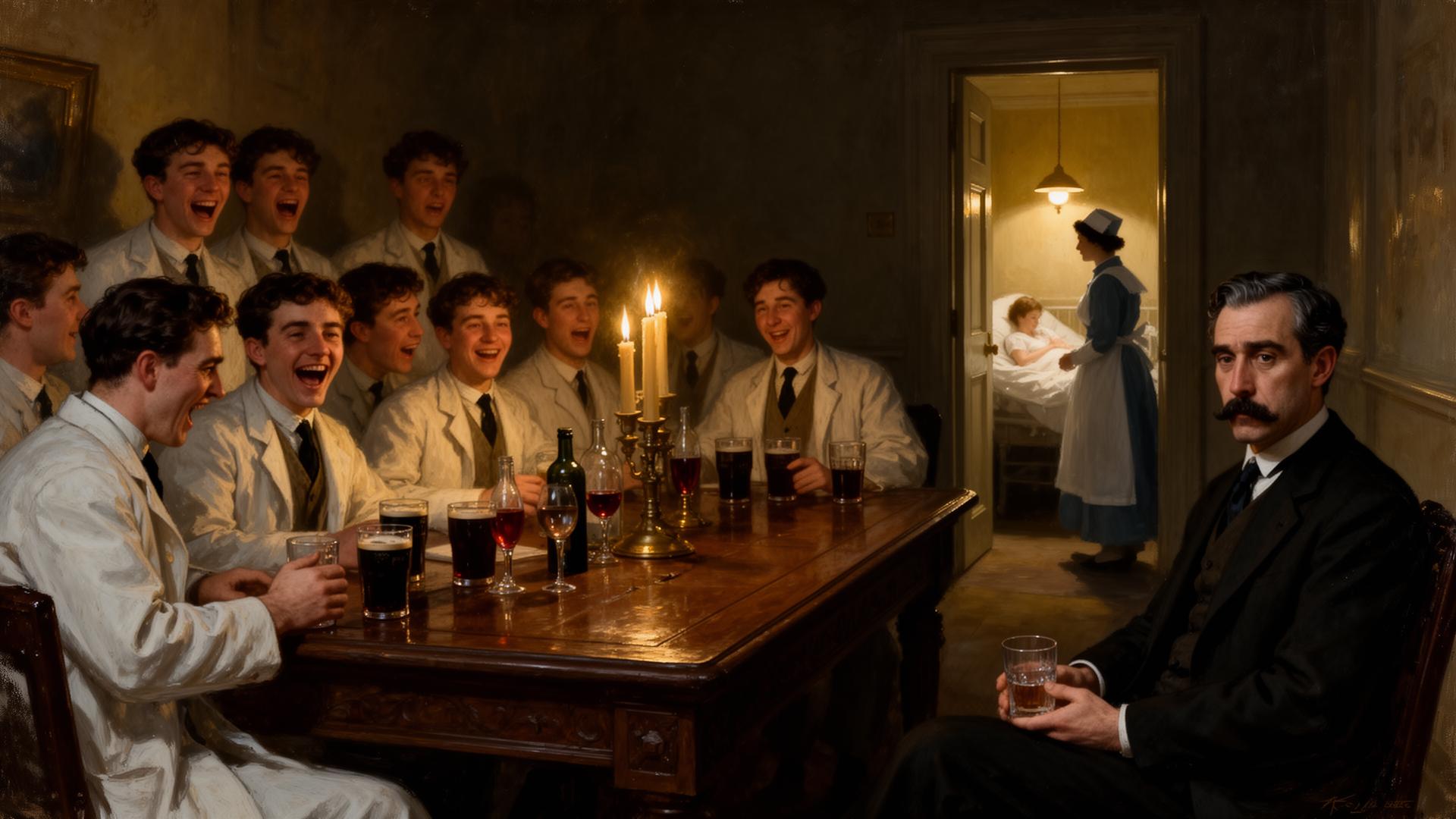
Painterly candlelit Edwardian scene in the common-room of the National Maternity Hospital, Holles Street: drunken medical students laughing around a heavy table; Leopold Bloom sits quietly to one side; through an open doorway a nurse moves toward a woman in labour.
National Maternity Hospital · Holles St · 10 p.m.
Programme — A History of English in One Night
Anglo-Saxon · Mandeville · Sterne · Dickens · Carlyle · Slang
Ep. XIV · 16 vi 1904
Episode XIV · Oxen of the Sun · Birth & Style

Oxen of the Sun: A Language Being Born.

Episode 14 of Ulysses moves Homer's slaughter of the sacred cattle of Helios into the common-room of a Dublin maternity hospital — and stages the 'crime against fecundity' across the entire history of English prose, from Anglo-Saxon to modern slang, while a child is born one room away.

"Before born babe bliss had. Within womb won he worship."
Ulysses, Episode 14 (Anglo-Saxon pastiche)
L
Leopold Bloom
The reverent guest
M
Mrs Purefoy
Labouring upstairs
O
Odysseus
Refused the cattle
H
Helios
Owner of the herd
Plain-English mode
Scroll to begin
§1 · Why "Oxen of the Sun"?

A hospital, a herd, a history of English.

In Book 12 of the Odyssey, the starving crew slaughter the sacred cattle of the sun-god Helios despite Odysseus' warning. Zeus destroys their ship; only Odysseus, who would not touch the herd, survives.

Joyce moves that sin to the National Maternity Hospital on Holles Street. The 'sacred cattle' are human fertility itself — Mrs Purefoy in labour upstairs, the unborn child — and the slaughterers are a roomful of drunken medical students whose contraceptive jokes and sterile cleverness desecrate, in Joyce's reading, the act of giving life. Bloom alone is reverent. And while the child is being born, the prose itself is born, decade by decade, through the whole history of English style.

The herd becomes a woman in labour; the slaughter becomes a clever joke.

  1. c. 8th c. BCE
    Homer's Odyssey
    Odysseus' crew slaughter the sacred cattle and are destroyed
  2. c. 700–1900
    English prose history
    From Anglo-Saxon to Newman — the styles Joyce pastiches
  3. 16 June 1904, ~10 p.m.
    National Maternity Hospital
    Mrs Purefoy labours; the students drink; Bloom worries
  4. 1918–20
    Drafted
    The most labour-intensive chapter Joyce ever wrote — 1000+ hours
  5. 1922
    Publication
    Ulysses appears in Paris
§2 · Odyssey Primer

The Cattle of the Sun in The Odyssey — in brief.

Circe and the dead seer Tiresias both warn Odysseus that on the island of Thrinacia he will find the immortal herds of the sun-god Helios. He is to leave them untouched on pain of total destruction.

Storm-bound on the island for a month, the crew run out of food. Odysseus is asleep when his men, led by Eurylochus, kill and roast the sacred cattle. The hides crawl on the ground; the meat lowers on the spits. Helios complains to Zeus, who, when they sail, smashes the ship with a thunderbolt. Only Odysseus, who would not eat, survives.

Joyce takes this episode — sin against life, divine retribution, lone survivor — and translates it into a single Dublin night in a maternity hospital.

§3 · How Homer becomes Dublin

Six transformations, from Thrinacia to Holles Street.

Homer
Helios' immortal herd on Thrinacia
Joyce
Human fertility — the labouring woman upstairs

Homer's cattle are literally sacred: they belong to a god and they are not to be touched. Joyce's equivalent is the body of Mrs Purefoy, three days in labour, and the unborn child she is bringing into the world. The sacredness has moved from a god's possession to the simple human fact of birth — and the sin will be measured against that.

Hooray! Ay! Whrrwhee! … Mort aux vaches! … The black crook with his anatomy of the marrow.
Ulysses, Episode 14 (the students drinking)
fertilityMrs Purefoysacred
§4 · Who's Who

Homeric counterparts in Episode 14.

Oxen of the Sun stages a hospital common-room as Thrinacia — and quietly judges every man in it by his attitude to the labour upstairs.

UlyssesOdyssey counterpartNote
Leopold BloomOdysseus refusing the cattleThe only man present treating the labour as sacred
Mrs Mina PurefoyHelios' sacred herdHer labour is the chapter's hidden centre
Stephen DedalusThe chief sinnerBuys the round, jokes about contraception, is terrified by thunder
The medical studentsThe starving crewSin against fecundity through sterile cleverness
Buck MulliganThe arch-mockerProposes a 'national fertilising farm' as a joke
The newborn boyA new oxMortimer Edward Purefoy — life arriving in the room of words
The thunderclapZeus' lightningDivine wrath shrunk to a noise that frightens Stephen
Linati Schema (1920)

Scene: The Hospital. Art: Medicine. Symbol: Mothers. Technique: Embryonic development.

Gilbert Schema (1921)

Organ: womb. Colour: white. Hour: 10 p.m.

Homeric correspondences

Cattle → fertility. Slaughterers → students. Bloom → Odysseus abstaining.

§5 · Key themes

Ten threads through the night of birth.

Fertility

The sacred 'crime' is against birth itself.

Style

Nine centuries of English prose, in order.

Embryo

Language gestates while the child gestates.

Cleverness

Wit divorced from care is the modern sin.

Decency

Bloom as the unobtrusive moral centre.

Rudy

Bloom's lost son haunts the room.

Thunder

A single clap = the entire divine storm.

Bloom & Stephen

The protective bond is sealed here.

Latin

Opening's mock-Latin marks a pre-literate beginning.

Nighttown

The chapter ends pointing toward Circe.

§6 · Quotations & close reading

Homer beside Joyce.

Homer

"Hyperion of the Sun caught them as they ate his sacred cattle. … He spoke in anger and bade Zeus and the other gods punish the men of Odysseus."

Odyssey, Book XII

Joyce

"Universally that person's acumen is esteemed very little perceptive concerning whatsoever matters are being held as most profitable by mortals with sapience endowed to be studied who is ignorant of that which the most in doctrine erudite…"

Ulysses, Episode 14 (opening)

Why this matters

Homer's accusation is delivered in a god's plain anger; Joyce opens with a Latinate sentence so contorted it nearly collapses under itself. The 'crime' begins in the language itself — speech that has lost the capacity to be simple.

Homer

"The flayed hides began to crawl, and the flesh on the spits, both the cooked and the raw, bellowed, and a sound as of cattle was heard."

Odyssey, Book XII

Joyce

"A black crack of noise in the street here, alack, bawled, back. Loud on left Thor thundered: in anger awful the hammerhurler."

Ulysses, Episode 14

Why this matters

The Homeric omens are gory and bodily; Joyce's omen is a single thunderclap that terrifies Stephen. The supernatural has migrated from the meat on the spit to the conscience of a young man.

Homer

"The men feasted on the herds, weeping; for they knew now that they would not return."

Odyssey, Book XII

Joyce

"Burke's! outflings my lord Stephen, giving the cry, and a tag and bobtail of all them after."

Ulysses, Episode 14 (closing)

Why this matters

Homer's crew know they are doomed and feast anyway. Joyce's company knows nothing of the kind — they spill out toward a pub and then a brothel, the modern feast continuing in language that has finally collapsed into pure slang.

§7 · Modernity vs Epic

Divine cattle, rewritten as a hospital ward.

Homer

Sacred herd, divine punishment

Hungry sailors eat a god's cattle and a thunderbolt smashes their ship. The sin is literal, the punishment is cosmic, the only survivor is the man who refused the meal.

Joyce

A labouring woman, a roomful of jokes

Drunken students play with words while a woman labours; the punishment is the gradual rot of their own language until it is pure slang. The 'survivor' is a quiet middle-aged Jew who keeps thinking of his dead son.

Joyce keeps the moral shape — sin against life, slow ruin of the sinners — and changes everything else: the god becomes a woman, the storm becomes a style, the meat becomes a sentence.

§8 · Why this episode matters

The novel's most ambitious set-piece — and the night Bloom becomes a father again.

Oxen is Joyce at his most virtuosic — a single chapter that performs the entire history of English prose while a woman gives birth in the next room. It is the chapter that earned Ulysses its reputation for difficulty, and it is the chapter Joyce sweated over longest.

It is also the moral pivot of the second half of the book. Bloom watches Stephen drink, sees the boy's danger, and decides — without saying so — to follow him to Nighttown and watch over him. The father-son plot of Ulysses, the substitute paternity that will replace the lost Rudy, begins here, in the room where a real child is being born.

A language is born, a child is born, and a middle-aged man quietly decides to become a father to a stranger.

§9 · FAQ

Quick answers.

  • Joyce maps Episode 14 onto Book 12 of the Odyssey, where Odysseus' starving crew slaughter the sacred cattle of the sun-god Helios despite his explicit warning, and are destroyed for the sin. The Joycean equivalent of those sacred oxen is human fertility itself: Joyce sets the chapter in the National Maternity Hospital while Mrs Mina Purefoy labours upstairs, and surrounds the unborn child with a crowd of drunken medical students whose contraceptive jokes, sterile cleverness and abuse of language all constitute, in his schema, a 'crime against fecundity'.