The reading room of the National Library of Ireland: a young Stephen Dedalus in a black hat argues his Shakespeare theory across an oak table to bearded Dublin scholars, beneath green-shaded brass lamps, with the ghostly silhouettes of a six-headed monster and a whirlpool flanking a central column — Joyce's Scylla and Charybdis.
National Library of Ireland · Catalogue Card
Dedalus, Stephen.
A theory concerning the ghost in Hamlet.
Shelf · Ep. IX · 16 vi 1904
Episode IX · Scylla & Charybdis · Dialectic & the Father

Scylla & Charybdis: A Theory Between Two Monsters.

Episode 9 of Ulysses moves Homer's narrow strait into the librarian's office of the National Library — and steers Stephen Dedalus's Shakespeare theory between Aristotle's rock and Plato's whirlpool while Bloom passes silently through.

"A man passed out between them, bowing, greeting."
Ulysses, Episode 9
S
Stephen Dedalus
Arguing Hamlet
B
Buck Mulligan
Mocking, late
O
Odysseus
Hand on the tiller
S
Scylla & Charybdis
Two deaths, no third way
Plain-English mode
Scroll to begin
§1 · Why "Scylla & Charybdis"?

Two monsters, one young man's argument.

In Book 12 of the Odyssey, Circe warns Odysseus that he must steer his ship through a narrow strait flanked by two inescapable deaths: Scylla, a six-headed monster on the cliff, and Charybdis, a whirlpool that sucks down whole ships. There is no third route.

Joyce relocates the strait to the librarian's office of the National Library of Ireland. Stephen Dedalus, performing his Hamlet theory before a small audience of Irish literati, must steer between Aristotelian fact (the rock of biography) and Platonic mysticism (the whirlpool of formless idea) — and keep his argument afloat.

The epic strait becomes a sentence held precisely on course.

  1. c. 8th c. BCE
    Homer's Odyssey
    Odysseus passes between Scylla and Charybdis
  2. c. 1601
    Shakespeare writes Hamlet
    The play Stephen reads as autobiographical
  3. 1890s
    Irish Literary Revival
    AE, Yeats, Eglinton shape the room Stephen will face
  4. 16 June 1904, ~2 p.m.
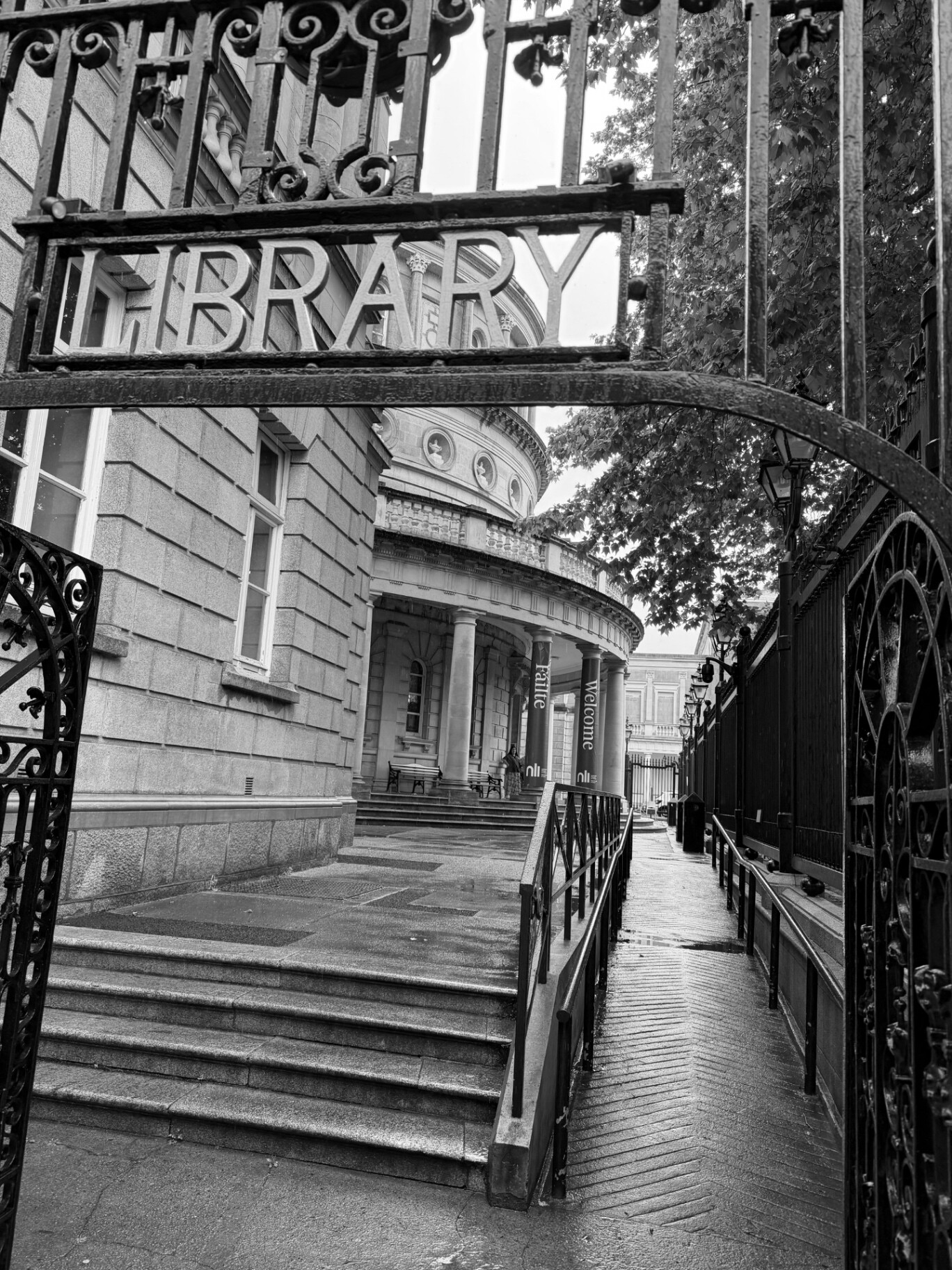
    National Library, Kildare St.
    Stephen's Shakespeare lecture in the librarian's office
  5. 1922
    Publication
    Ulysses appears in Paris
§2 · Odyssey Primer

Scylla and Charybdis in The Odyssey — in brief.

Leaving Circe's island, Odysseus is warned of a narrow strait. On one side is Scylla, a six-headed monster who will pluck six of his men from the ship; on the other is Charybdis, a whirlpool who would swallow the ship entire.

Circe's grim counsel: better to lose six men to Scylla than the whole crew to Charybdis. Odysseus, against orders, arms himself and tries to face the monster — and loses his six men anyway. The ship sails through.

Book 12 is the Odyssey's parable of impossible choice — and Joyce takes it as his template for the chapter in which Stephen, like Odysseus, must accept a partial loss to keep his argument moving.

Rock
Whirl
Book
Ghost
Strait
§3 · How Homer becomes Dublin

Six transformations, from the strait to the library.

Homer
Odysseus steering between two monsters
Joyce
Stephen Dedalus arguing his Shakespeare theory

Circe warns Odysseus he must pass between Scylla and Charybdis: there is no third route. Stephen, in the librarian's office, must argue his Hamlet theory between the rock of dogmatic Aristotelianism and the whirlpool of theosophical Platonism. The hero's hand on the tiller becomes a young man's sentence held precisely between two intellectual deaths.

—I think you're getting on very nicely. Just mix up a mixture of theolologicophilolological. Mingo, minxi, mictum, mingere.
Ulysses, Episode 9 (Mulligan)
dialecticShakespeareargument
§4 · Who's Who

Homeric counterparts in Episode 9.

Scylla & Charybdis stages the National Library as Homer's strait — a narrow room in which every word risks one of two philosophical drownings.

UlyssesOdyssey counterpartNote
Stephen DedalusOdysseus at the straitSteering between two intellectual deaths
John EglintonScylla (Aristotelian rock)Sceptical, biographical, immovable
AE (George Russell)Charybdis (Platonic whirlpool)Theosophical, formless, dissolving
Buck MulliganThe tempting crewmanHis comic interruptions threaten to sink the argument
Lyster, Best (librarians)The crew at the oarsPolite, helpful, slightly afraid
Leopold BloomOdysseus glimpsed from afarPasses between Stephen and Mulligan on the library steps
Linati Schema (1920)

Scene: The Library. Art: Literature. Symbol: Stratford — London (the doubled cities of Shakespeare).

Gilbert Schema (1921)

Organ: brain. Technique: dialectic. Colour: none specified.

Homeric correspondences

Scylla → Aristotle / Eglinton. Charybdis → Plato / AE. Odysseus → Stephen at argument.

§5 · Key themes

Ten threads through the library afternoon.

Dialectic

The chapter is built as a Socratic skirmish: thesis vs whirlpool.

Shakespeare

Hamlet read as autobiography — and Stephen's veiled self-portrait.

Fatherhood

Stephen's argument is really about the missing father Bloom will become.

Aristotle vs Plato

Substance vs spirit, fact vs essence, Stratford vs Theosophy.

The library

The chapter's sole location: Kildare Street, the room of the librarians.

Mulligan

The comic Charybdis: laughter that would suck all meaning down.

Hamnet

Shakespeare's dead son, the silent ghost behind the chapter's theory.

Anne Hathaway

The cuckolded biography Stephen needs — and Bloom is living.

Mathematics

Schema-art Literature; the chapter delights in formal structure.

The threshold

Bloom's passing between Stephen and Mulligan: the day's central near-miss.

§6 · Quotations & close reading

Homer beside Joyce.

Homer

"On the one hand lay Scylla and on the other mighty Charybdis terribly sucked down the salt sea water."

Odyssey, Book XII (public domain trans.)

Joyce

"—Our young Irish bards, John Eglinton censured, have yet to create a figure which the world will set beside Saxon Shakespeare's Hamlet."

Ulysses, Episode 9

Why this matters

Homer's literal two-monster strait becomes a literary argument with the same shape: two opposing pressures, no middle, and a young man trying to hold his course between them.

Homer

"Better far to lose six of thy company than thy whole crew."

Odyssey, Book XII (Circe to Odysseus)

Joyce

"Stephen withstood the bane of miscreant eyes glinting stern under wrinkled brows. … He laughed to free his mind from his mind's bondage."

Ulysses, Episode 9

Why this matters

Circe's grim arithmetic — accept some loss to save the ship — becomes Stephen's strategy of forced laughter. He sacrifices a piece of his theory rather than be eaten whole.

Homer

"Three times in the day she belcheth it forth, and three times a day she sucketh it down terribly."

Odyssey, Book XII (Charybdis)

Joyce

"Formless spiritual. … Plato's world of ideas. Allfather, the heavenly man."

Ulysses, Episode 9

Why this matters

Charybdis's cyclical swallowing is Joyce's image for Russell's theosophy: a perpetual oral motion that takes in everything and produces only itself.

§7 · Modernity vs Epic

Two sea-monsters, rewritten as two philosophies.

Homer

Physical strait

A hero clutches the tiller of a small ship and steers between two literal monsters of stone and water. The danger is salt.

Joyce

Mental strait

A young man in a small library room holds a Shakespeare argument together between fact and mysticism. The danger is being right about the wrong thing.

Joyce keeps the strait and changes the substance — the sea has been replaced by the syllabus.

§8 · Why this episode matters

The novel's intellectual centre — and its first crossing.

Scylla & Charybdis is Stephen's chapter: his most sustained performance, his most polished theory, and his clearest confession. The Shakespeare argument is really an argument about needing a father, and Bloom — who walks unseen between him and Mulligan on the way out — is the answer Stephen cannot yet recognise.

The chapter is also the end of the novel's morning. From here Joyce abandons even the pretence of orderly narration and the stylistic experiments take over. The hero has passed the strait; the open sea is everything that follows.

Two ships, two strangers, one doorway. The Odyssey resumes in the threshold.

§9 · FAQ

Quick answers.

  • Joyce maps Episode 9 onto Book 12 of the Odyssey, where Odysseus must steer his ship between the six-headed monster Scylla and the whirlpool Charybdis. Joyce calls his chapter 'Scylla and Charybdis' because Stephen Dedalus, in the National Library, must steer his Shakespeare theory between the two equally dangerous philosophical poles of Aristotle (the rock) and Plato (the whirlpool).