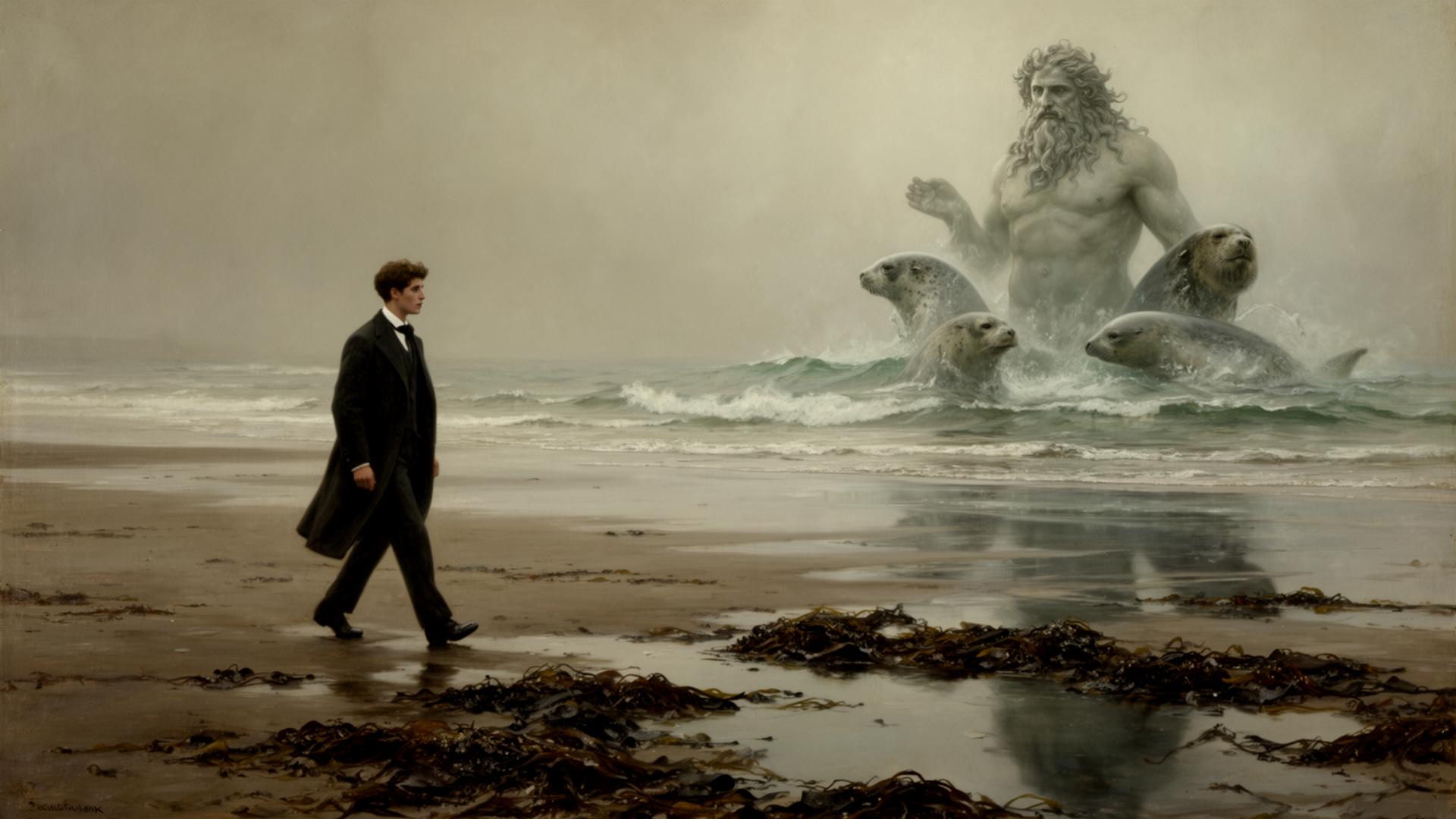
A solitary Edwardian figure walking on Sandymount Strand at low tide, the horizon dissolving into the shape of the sea-god Proteus rising from the waves.
Episode III · Proteus · Perception & Language

Proteus: Joyce's Wrestling Match with the Visible World.

Episode 3 of Ulysses turns Homer's shape-shifting sea-god into a meditation on perception, language, exile and the metamorphosing surface of reality itself.

"Ineluctable modality of the visible: at least that if no more, thought through my eyes."
Ulysses, Episode 3
S
Stephen Dedalus
Walker on the strand
T
The dead dog
Memento mori on the sand
M
Menelaus
King of Sparta
P
Proteus
Old Man of the Sea
Plain-English mode
Scroll to begin
§1 · Why "Proteus"?

A shape-shifting god, a shape-shifting mind.

In Book 4 of the Odyssey, Menelaus is trapped on the island of Pharos and must wrestle the sea-god Proteus to learn how to get home. The god changes shape — lion, serpent, water, tree — and Menelaus must hold on through every transformation until the truth is spoken.

Joyce moves the wrestling match indoors, into the mind. Stephen Dedalus walks alone along Sandymount Strand and wrestles the equally slippery world of appearances: the sand under his boots, the kelp at the tideline, the dead dog, the voices of his mother and his exiled friends. Each looked-at thing slips into something else.

Heroic wrestling becomes the modern act of perception itself.

  1. c. 8th c. BCE
    Homer's Odyssey
    Menelaus wrestles Proteus on Pharos
  2. 5th–4th c. BCE
    Greek philosophy
    Aristotle's modalities — Stephen's tools
  3. 17th–18th c.
    Berkeley & empiricism
    Does the world exist when unseen?
  4. 16 June 1904
    Sandymount Strand
    Stephen walks alone, around 11 a.m.
  5. 1922
    Publication
    Ulysses appears in Paris
§2 · Odyssey Primer

Proteus in The Odyssey — in brief.

In Book 4 of the Odyssey, Telemachus visits Menelaus in Sparta and hears the story of Menelaus's own troubled return from Troy. Becalmed on the island of Pharos near Egypt, Menelaus is starving — until Eidothea, daughter of Proteus, tells him how to capture her shape-shifting father and force him to speak.

At noon, Proteus rises from the sea to count his seals. Disguised in sealskins, Menelaus and his men leap on him and hold tight as he becomes lion, serpent, leopard, boar, water and tree. When at last he tires, he tells Menelaus how to appease the gods and sail home — and gives him news of Odysseus, alive but trapped on Calypso's island.

The episode is about endurance and the violent extraction of truth from a world that resists being known.

Tide
Vision
Shapeshift
Memory
Sand
§3 · How Homer becomes Dublin

Six transformations, from Pharos to Sandymount.

Homer
Menelaus on the beach of Pharos
Joyce
Stephen on Sandymount Strand

In Homer, Menelaus holds the slippery sea-god down through every transformation — lion, serpent, panther, water, tree — until Proteus yields his truth. Joyce relocates the struggle inward. Stephen wrestles not a god but his own perceptions: the shifting world of the strand and the equally shifting world of his own thought.

Ineluctable modality of the visible: at least that if no more, thought through my eyes.
Ulysses, Episode 3
perceptionconsciousnessphilosophy
§4 · Who's Who

Homeric counterparts in Episode 3.

In Proteus, the Homeric parallels are atmospheric rather than one-to-one. Stephen plays Menelaus alone — there is no Bloom yet, and the sea-god is the visible world itself.

UlyssesOdyssey counterpartNote
Stephen DedalusMenelausThe lone wrestler at the shoreline
The shifting visible worldProteusThe shape-shifter to be pinned down
Stephen's dead motherEidothea (helper-figure)Voice from the unseen that instructs him
Kevin Egan (in Paris)Exiled comrade-figureMemory of the Irish exile's life abroad
The cocklepickers & dogSeals on the beach of PharosOther creatures of the shoreline
Sandymount StrandPharos, the island shoreLiminal place where revelation happens
Linati Schema (1920)

Scene: The Strand. Art: Philology. Symbol: tide.

Gilbert Schema (1921)

Organ: none. Technique: Monologue (male). Colour: green.

Homeric correspondences

Menelaus → Stephen. Proteus → the visible. Eidothea → memory.

§5 · Key themes

Ten threads through the strand.

Perception

The 'ineluctable modality of the visible' — the inescapable condition of seeing.

Metamorphosis

Every object becomes another: kelp into hair, sand into thought.

Language

Joyce's prose shape-shifts as fluidly as the sea-god himself.

Exile

Stephen is at home in Ireland and yet a stranger; Paris hums underneath.

The dead

His mother, drowned men, the dog on the sand — death is the chapter's tide.

Philosophy

Aristotle, Berkeley, Boehme — thinkers walk beside Stephen on the strand.

Solitude

After the tower and the schoolroom, the third refusal: company itself.

Time

Nacheinander, nebeneinander — time as sequence, space as simultaneity.

Vocation

What kind of artist can Stephen become? The chapter is an audition.

The body

Urine, snot, blood, milk — the world insists on its physical truth.

§6 · Quotations & close reading

Homer beside Joyce.

Homer

"Could you only somehow lie in wait and catch him, he would tell you the way and the length of your journey, and of your homecoming, how you may sail over the fishy sea."

Odyssey, Book IV (public domain trans.)

Joyce

"Ineluctable modality of the visible: at least that if no more, thought through my eyes. Signatures of all things I am here to read…"

Ulysses, Episode 3

Why this matters

Both passages stage a single figure on a shore, determined to read what the world is hiding. Homer's hero ambushes a god for an answer; Joyce's hero ambushes the visible itself, hoping that perception, properly attended to, will yield up its 'signatures'.

Homer

"He turned into a great bearded lion, and then to a serpent, then to a leopard, then to a great boar, and he turned into fluid water, to a tree with towering branches…"

Odyssey, Book IV

Joyce

"Wombed in sin darkness I was too, made not begotten. By them, the man with my voice and my eyes and a ghostwoman with ashes on her breath."

Ulysses, Episode 3

Why this matters

Where Proteus shifts shape externally, Stephen's mind shifts inwardly — from theology to biology to memory in a single sentence. Joyce internalises the Homeric metamorphosis: the transformations now happen at the level of thought and prose.

Homer

"Then at last the unfailing Old Man of the Sea spoke, and answered."

Odyssey, Book IV

Joyce

"Who watches me here? Who ever anywhere will read these written words?"

Ulysses, Episode 3

Why this matters

Homer's wrestled god finally yields the saving sentence. Joyce's wrestler is left, instead, with a question: not 'what is the truth?' but 'will anyone receive what I write?' The Homeric homecoming becomes the modern writer's question of readership.

§7 · Modernity vs Epic

Heroic combat, rewritten as inward attention.

Homer

Outward struggle

Menelaus wrestles a god and physically pins him until the truth is spoken. The drama is bodily, public, decisive. Reality may shift form, but it can be made to stand still.

Joyce

Inward attention

Stephen's wrestling is silent, solitary and never resolved. The visible refuses to yield a single truth — only signatures, only metamorphoses. Modern heroism is the discipline of attention itself.

Joyce keeps the wrestling match but moves the arena inside the mind, where the fight goes on forever.

§8 · Why this episode matters

The Telemachiad closes; the novel changes element.

Proteus is the third and final movement of the Telemachiad. Having walked out of the tower (Telemachus) and the schoolroom (Nestor), Stephen now walks out of company itself. The page becomes pure consciousness — the technique Joyce will hand to Bloom in the next chapter and to Molly at the end of the book.

The episode also stages, in advance, the central question of Ulysses: can the world be read? Stephen's "signatures of all things" prepare us for a novel that will treat every object — a kidney, a soap bar, a newspaper — as a piece of language waiting to be deciphered.

Once Stephen has wrestled the visible, the novel can hand the wrestling on to Bloom — and to us.

§9 · FAQ

Quick answers.

  • Joyce maps Episode 3 onto Book 4 of the Odyssey, where Menelaus wrestles the shape-shifting sea-god Proteus to extract the truth about his journey home. Joyce calls the chapter 'Proteus' because Stephen Dedalus, walking alone on Sandymount Strand, wrestles with a comparable adversary: the flickering, ever-changing world of appearances, language and his own thought.