Molly Bloom reclining in bed in a sunlit Edwardian bedroom; Leopold Bloom walks away in the distance toward the sea, the horizon dissolving into the silhouette of Calypso's island.
Episode IV · Calypso · Marriage & the Domestic Epic

Calypso: Joyce's Island in a Dublin Bedroom.

Episode 4 of Ulysses turns Homer's nymph-island into 7 Eccles Street — and introduces the most ordinary, most affecting hero in twentieth-century fiction: Leopold Bloom, preparing breakfast.

"Mr Leopold Bloom ate with relish the inner organs of beasts and fowls."
Ulysses, Episode 4
L
Leopold Bloom
Advertising canvasser
M
Molly Bloom
Concert soprano, in bed
O
Odysseus
Held on Ogygia
C
Calypso
Nymph, daughter of Atlas
Plain-English mode
Scroll to begin
§1 · Why "Calypso"?

A nymph's island, a marriage bed.

In Book 5 of the Odyssey, Odysseus has been held seven years by the nymph Calypso on the island of Ogygia. She loves him, feeds him, offers him immortality — and yet he weeps every day for Ithaca. Hermes is sent by Zeus to command his release.

Joyce relocates the island to a Georgian terrace in north Dublin. Bloom is held not by a goddess but by a woman in a brass bed; not by enchantment but by tea, bacon and twelve years of marriage. The captivity is real and loving — and so is the leaving.

The epic island is rewritten as the most familiar room you know.

  1. c. 8th c. BCE
    Homer's Odyssey
    Odysseus held seven years on Ogygia
  2. 1880s
    Bloom's youth
    Born in Dublin; family roots in Hungary
  3. 1888
    Marriage to Molly
    On the Hill of Howth, with the seedcake
  4. 16 June 1904, 8 a.m.
    7 Eccles Street
    Bloom makes Molly's breakfast
  5. 1922
    Publication
    Ulysses appears in Paris
§2 · Odyssey Primer

Calypso in The Odyssey — in brief.

After the wreck of his last ship, Odysseus is washed up on the island of Ogygia, where the nymph Calypso takes him in. She loves him, keeps him for seven years and offers him eternal life if he will stay.

On Mount Olympus, Athena pleads his case. Zeus sends Hermes to Calypso with an order: release the man. Calypso receives the command bitterly, but obeys. She gives Odysseus tools to build a raft, food and wine for the voyage, and a fair wind.

Book 5 is the Odyssey's domestic interior — a chapter of food, speech and shared mornings before the sea-journey resumes. Joyce takes it as his template for the morning of Leopold Bloom.

Sun
Bed
Letter
Kettle
Kidney
§3 · How Homer becomes Dublin

Six transformations, from Ogygia to Eccles Street.

Homer
Odysseus, held on Ogygia
Joyce
Leopold Bloom in 7 Eccles Street

Homer's Odysseus has been kept seven years on Calypso's island, weeping by the sea. Joyce's Bloom is held, far more gently, by the rhythms of marriage and breakfast. The epic captivity is rewritten as a tender, slightly comic domesticity — and yet the longing for departure is just as real.

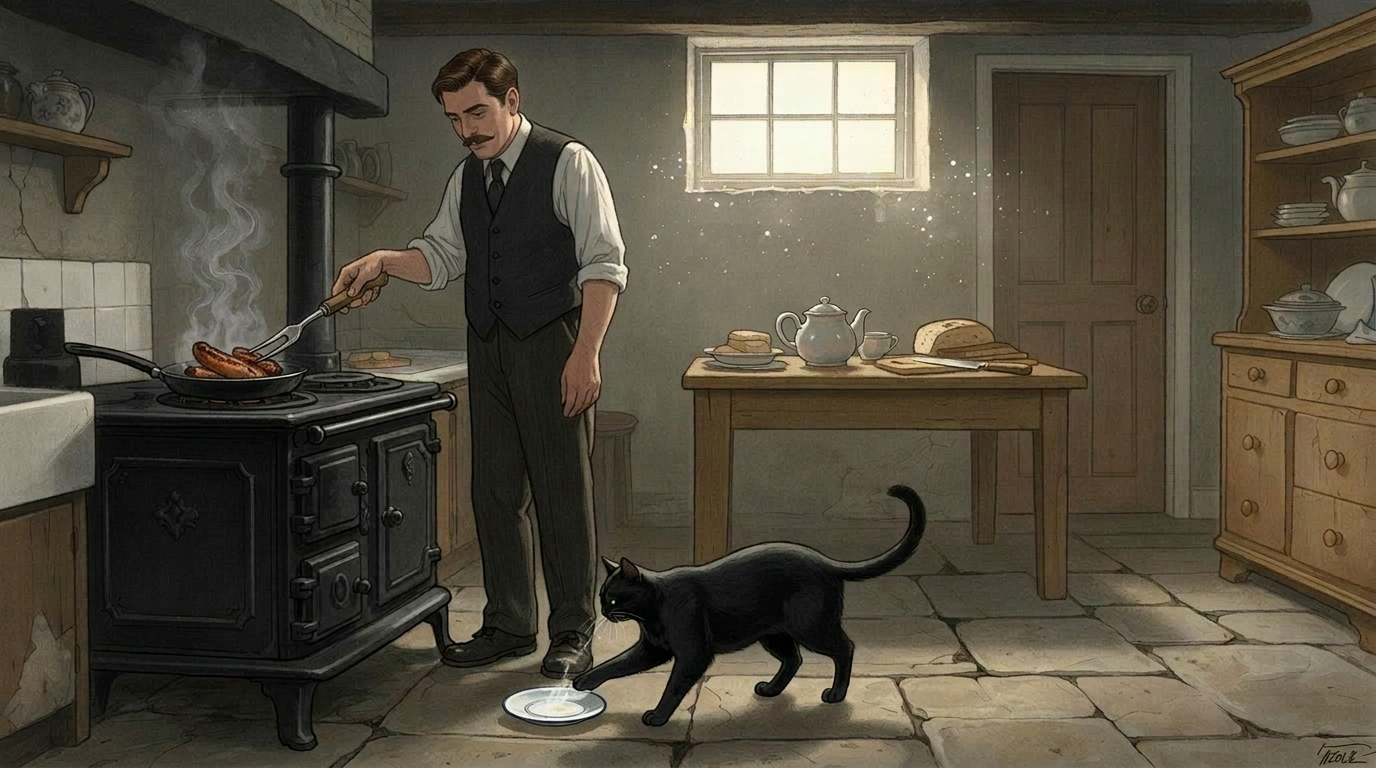
Mr Leopold Bloom ate with relish the inner organs of beasts and fowls.
Ulysses, Episode 4
bodydomesticityintroduction
§4 · Who's Who

Homeric counterparts in Episode 4.

Calypso introduces Bloom and Molly as Odysseus and his loving captor — and quietly plants Boylan as the rival who will return.

UlyssesOdyssey counterpartNote
Leopold BloomOdysseusThe held hero preparing to leave
Molly BloomCalypsoThe loving captivity that is also home
Milly Bloom (in Mullingar)Telemachus / news of familyThe absent child whose letter cheers the father
Blazes BoylanRival / future shadowNot in the Odyssey — Joyce's modern intruder, signalled by his letter
7 Eccles StreetOgygiaThe intimate island that holds the hero
The catCreatures of Calypso's islandDomesticated mythology — Mkgnao replaces the nymphs
Linati Schema (1920)

Scene: The House. Art: Economics. Symbol: vagina (the nymph's cave, domesticated).

Gilbert Schema (1921)

Organ: kidney. Technique: Narrative (mature). Colour: orange.

Homeric correspondences

Odysseus → Bloom. Calypso → Molly. Hermes → the post.

§5 · Key themes

Ten threads through the morning.

Domesticity

The epic relocated to the kitchen, the kettle and the cat.

The body

Kidney, urine, menstruation, smell — Bloom's world is unembarrassed flesh.

Marriage

Tender, frayed, real — Molly and Bloom as a working modern couple.

The East

Agendath Netaim, oranges, sun — a fantasy elsewhere lights the morning.

The letter

Post arrives as joy (Milly) and as future wound (Boylan).

Time

8 a.m. — the same morning as Stephen's; Joyce restarts the clock.

Money

Schema-art Economics: prices, butcher's coins, household accounting.

Fatherhood

Milly's letter introduces the missing/found-child theme of the novel.

Animals

The cat is granted interiority — the chapter widens kinship.

Departure

Every gesture quietly prepares the door, the latchkey, the leaving.

§6 · Quotations & close reading

Homer beside Joyce.

Homer

"Him she found sitting on the shore, and his eyes were never dry of tears, and his sweet life was ebbing away as he longed mournfully for his return."

Odyssey, Book V (public domain trans.)

Joyce

"Somewhere in the east: early morning: set off at dawn. Travel round in front of the sun, steal a day's march on him."

Ulysses, Episode 4

Why this matters

Homer's hero weeps for the home he cannot reach; Joyce's hero fantasises about a home he never had. The Homeric nostos is split into nostalgia and reverie — Bloom longs forward, not back.

Homer

"In the cave a great fire was burning, and from afar the fragrance of cleft cedar and juniper rose sweetly through the isle."

Odyssey, Book V

Joyce

"Kidneys were in his mind as he moved about the kitchen softly, righting her breakfast things on the humpy tray. … A kidney oozed bloodgouts on the willowpatterned dish."

Ulysses, Episode 4

Why this matters

The fragrant divine cave becomes a Dublin kitchen smelling of organ meat. Joyce keeps Homer's sensory richness and translates it downward into the unmistakably bodily.

Homer

"And the heart of Calypso, fair-tressed goddess, was wrung, and she spoke and addressed him."

Odyssey, Book V

Joyce

"—Mn, she said. … —Yes, what is it? he asked. —Scald the teapot."

Ulysses, Episode 4

Why this matters

The goddess's solemn speech becomes a sleepy 'Mn' and a domestic instruction. Joyce keeps the asymmetry of power — the woman in bed, the man in attendance — but utterly de-mythologises its register.

§7 · Modernity vs Epic

Divine captivity, rewritten as marriage.

Homer

Divine love

A goddess offers a mortal hero immortality and a paradise island in exchange for staying forever. Refusing her takes a god's command.

Joyce

Ordinary love

A wife asks her husband to scald the teapot and bring up the post. He does, with tenderness, and then leaves for a funeral. The heroism is simply attention.

Joyce keeps the island and removes the goddess — leaving us with love, which is harder.

§8 · Why this episode matters

The novel begins again — and discovers its hero.

Calypso is the most decisive structural moment in Ulysses: at 8 a.m., the same morning as the Telemachiad, Joyce resets the clock and introduces a second consciousness. From here Stephen and Bloom share a day they will not actually share until evening.

The chapter also defines Bloom's signature: a hero of attention. He notices the cat, the post, his wife's preferences, his daughter's handwriting, the smell of the kidney. The Odyssey is rebuilt out of these small acts of care.

The modern epic begins not with a sea-storm but with a kettle.

§9 · FAQ

Quick answers.

  • Joyce maps Episode 4 onto Book 5 of the Odyssey, where Odysseus is held on the island of the nymph Calypso. Joyce calls the chapter 'Calypso' because Leopold Bloom — our modern Odysseus — first appears tied to a domestic island: 7 Eccles Street, where his wife Molly lies in bed and quietly governs his morning.