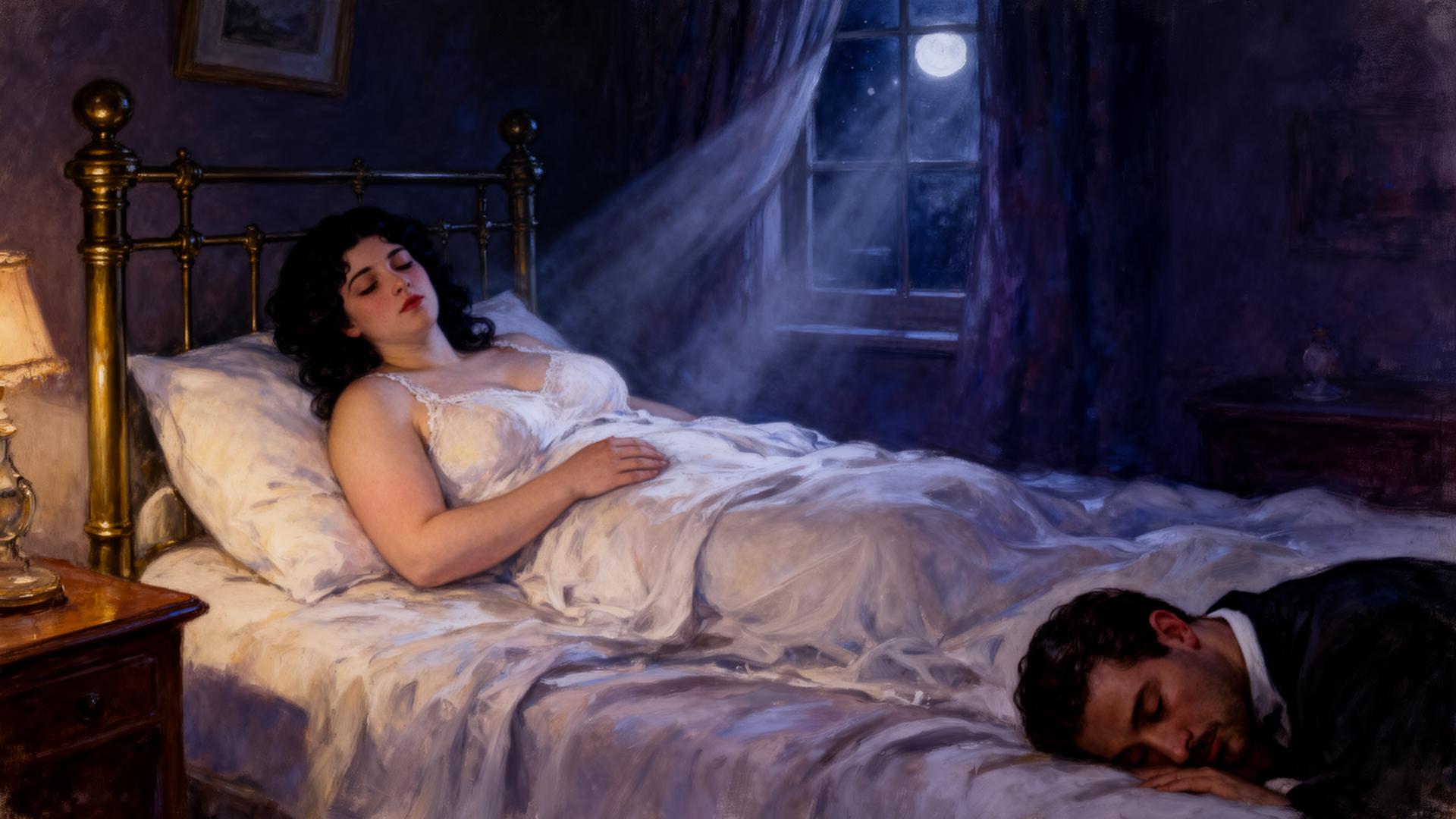
Painterly Edwardian Dublin bedroom at 7 Eccles Street, deep night: a dark-haired full-figured woman in a white nightgown half-awake in a brass bedstead with rumpled sheets; faint moonlight across her bare shoulder; her husband sleeping with his head at the foot of the bed beside her.
7 Eccles Street · Bedroom · After 2 a.m.
Monologue — Eight Sentences, No Stops
Gibraltar · Howth · Boylan · Bloom · Yes
Ep. XVIII · 17 vi 1904
Episode XVIII · Penelope · Molly Bloom's Yes

Penelope: The Earth Turning Yes.

Episode 18 of Ulysses gives the novel's final word to Molly Bloom — a half-awake, eight-sentence, unpunctuated stream that turns Homer's faithful queen into a Dublin singer remembering Gibraltar, Howth Head, her lovers and her husband, and closes on the most famous Yes in literature.

"and yes I said yes I will Yes."
Ulysses, Episode 18 (the novel's last words)
M
Molly Bloom
The earth, turning
L
Leopold Bloom
Asleep at her feet
P
Penelope
Queen of Ithaca
O
Odysseus
King returned
Plain-English mode
Scroll to begin
§1 · Why "Penelope"?

A queen of Ithaca, a woman in bed.

Homer's Penelope is the faithful queen who weaves and unweaves her shroud for twenty years, holding off her suitors, until Odysseus returns and is recognised through the secret of their bed.

Joyce gives the chapter — and the last word of his novel — to Molly Bloom: a Dublin concert soprano, lying half-awake at 2 a.m. on 17 June 1904, her husband asleep at her feet. Her mind unrolls in eight long unpunctuated sentences across the night: her afternoon with Boylan, her childhood in Gibraltar, Bloom's proposal on Howth Head, her body, her dead son Rudy, her living daughter Milly. The chapter ends on a single repeated word — yes — affirming Bloom, her body, her past, and the whole day the novel has just lived.

The Homeric queen becomes a woman talking to herself in the dark — and the novel is hers.

  1. c. 8th c. BCE
    Homer's Odyssey
    Penelope tests Odysseus and accepts him at last
  2. 1888
    Molly born in Gibraltar
    Daughter of Major Tweedy and Lunita Laredo
  3. 1888 (later)
    Bloom proposes on Howth Head
    The memory the chapter ends on
  4. 17 June 1904, ~2 a.m.
    7 Eccles Street, the bed
    The chapter's eight sentences begin
  5. 1921
    Drafted in Paris
    Joyce wrote the chapter last
§2 · Odyssey Primer

Penelope in The Odyssey — in brief.

For twenty years Penelope has waited in Ithaca while her husband fights at Troy and wanders home. For three of those years she has held off a crowd of suitors by promising to choose one when she finishes weaving a shroud for Odysseus' father — and undoing every night's work in secret.

When the disguised Odysseus returns and kills the suitors, she still does not at first accept him. She tests him: she orders the marriage bed moved. He answers that it cannot be moved, because its bedpost is a living olive tree rooted in the floor. Only her husband could know. She accepts him at last, and they go up to the rooted bed.

Joyce keeps the queen, the bed, and the choice — and changes everything about how the choice is made and what the woman is allowed to say.

§3 · How Homer becomes Dublin

Six transformations, from the loom to the bed.

Homer
Penelope of Ithaca
Joyce
Molly Bloom in 7 Eccles Street

Homer's Penelope is a queen in a palace, surrounded by suitors and faithful for twenty years. Joyce's Molly is a Dublin concert singer in a brass bed, who has slept with one man that afternoon and is married to another at her feet. The Homeric queen becomes a real, sleepy, embodied woman — half-irritated, half-tender, entirely herself — and the chapter belongs to her absolutely.

Yes because he never did a thing like that before as ask to get his breakfast in bed with a couple of eggs.
Ulysses, Episode 18 (opening)
Mollyqueenyes
§4 · Who's Who

Homeric counterparts in Episode 18.

Penelope stages the Eccles Street bedroom as the whole turning earth — every other character of the novel passes through Molly's mind in eight slow sentences.

UlyssesOdyssey counterpartNote
Molly BloomPenelopeLying in bed thinking; her mind is the chapter
Leopold BloomOdysseus returnedAsleep at the foot of the bed; the man her monologue keeps returning to
Blazes BoylanAntinous, the chief suitorSlept with that afternoon; remembered without enchantment
Lt. MulveyA first kiss on the RockGibraltar memory of Molly's first love
Major TweedyPenelope's father, IcariusMolly's army father in Gibraltar
RudyThe lost childBriefly mourned in passing; the chapter's quietest grief
Milly BloomTelemachia continuedMolly's living daughter, away in Mullingar
The brass bedsteadThe olive-rooted bedMolly's birth-bed and marriage bed; the chapter's location
Linati Schema (1920)

Scene: The Bed. Art: none specified. Symbol: Earth. Technique: Monologue (female).

Gilbert Schema (1921)

Organ: flesh. Colour: none. Hour: ∞.

Homeric correspondences

Penelope → Molly. Web → eight sentences. Olive bed → brass bedstead.

§5 · Key themes

Ten threads through the turning night.

Yes

First word, last word — the novel's affirmation.

Body

Menstruation, sex, milk, breath — a chapter of the flesh.

Memory

Howth, Gibraltar, childhood — past tense as present time.

Weaving

Eight long sentences turning like Penelope's loom.

Earth

Joyce's cosmic conception: Molly as the turning planet.

Boylan

Reviewed, judged, and finally relegated.

Bloom

Quietly chosen across the whole night.

Gibraltar

Sun-bleached childhood as the chapter's brightest light.

Rudy

A line, a pang, then onward — the chapter's grief.

Closure

The novel resolves on a single word.

§6 · Quotations & close reading

Homer beside Joyce.

Homer

"She set up a great loom in the palace and began to weave a wide web of fine thread, and said to us, 'Young men, my suitors, since the godlike Odysseus is dead, be patient until I finish this robe…'"

Odyssey, Book II

Joyce

"I love flowers Id love to have the whole place swimming in roses … the wild mountains then the sea and the waves rushing then the beautiful country with the fields of oats and wheat…"

Ulysses, Episode 18

Why this matters

Penelope's web is a literal cloth that delays a choice. Molly's web is the chapter itself — a long, returning, beautiful sentence that delays sleep and works the day into a pattern she can live with.

Homer

"Listen, all you who dwell in Ithaca: my husband has come, the famed Odysseus, and you slaughter has filled his hall."

Odyssey (paraphrase, Penelope's announcement)

Joyce

"I gave him all the pleasure I could leading him on till he asked me to say yes and I wouldnt answer first only looked out over the sea and the sky…"

Ulysses, Episode 18 (Howth memory)

Why this matters

Homer's announcement is public and political; Joyce's is private and erotic — the same act of recognition rewritten as a memory between two bodies on a hillside.

Homer

"Then they two went up to the place of their bed of old, glad to come together once more."

Odyssey, Book XXIII

Joyce

"and yes I said yes I will Yes."

Ulysses, Episode 18 (closing)

Why this matters

Homer's marriage is restored by an embrace in a rooted bed. Joyce's is restored by a single repeated word — the chapter and the novel ending on the smallest, fullest possible answer.

§7 · Modernity vs Epic

A faithful queen, rewritten as a real woman.

Homer

A loom, a test, a measured speech

A queen waits twenty years, weaves a shroud, tests her returning husband with a story about a bed, and consents to him in a formal speech. Fidelity is the chapter's frame and its question.

Joyce

A bed, a memory, one word

A Dublin singer who has slept with one man that afternoon lies in bed beside her husband, remembers his proposal sixteen years before on Howth Head, and accepts everything — her body, her past, her marriage — in a single repeated word: Yes.

Joyce keeps Penelope's choice and changes what is being chosen. Not fidelity as a virtue, but yes as the colour of consciousness.

§8 · Why this episode matters

The novel's final word — and the chapter that decides everything.

Penelope is the chapter that gives Ulysses its final shape. After seventeen episodes of Bloom and Stephen and Dublin, Joyce hands the closing forty pages — and the last word of the novel — to a woman lying in bed. He thereby insists that no account of his city, his epic, or his hero is complete without her.

It is also one of the most influential pieces of writing in modern fiction. The unpunctuated stream, the threshold-of-sleep voice, the way memory and body and judgement weave each other — these have shaped almost every interior-monologue chapter written since. And the closing Yes is more than a flourish: it is Joyce's argument that, for all the irony and grief and slaughter, the human answer to the day is still affirmation.

The novel of a single day ends on a single word — and the word is yes.

§9 · FAQ

Quick answers.

  • Joyce maps Episode 18 onto Books 18–23 of the Odyssey, in which Penelope, faithful queen of Ithaca, weaves and unweaves her web, holds off her suitors for twenty years, and finally accepts Odysseus through the test of their rooted bed. The Joycean equivalent is Molly Bloom: a Dublin singer lying half-awake at around 2 a.m. on 17 June 1904, her husband sleeping at the foot of the bed, her mind unrolling in eight enormous unpunctuated sentences toward the novel's last word, 'Yes'.