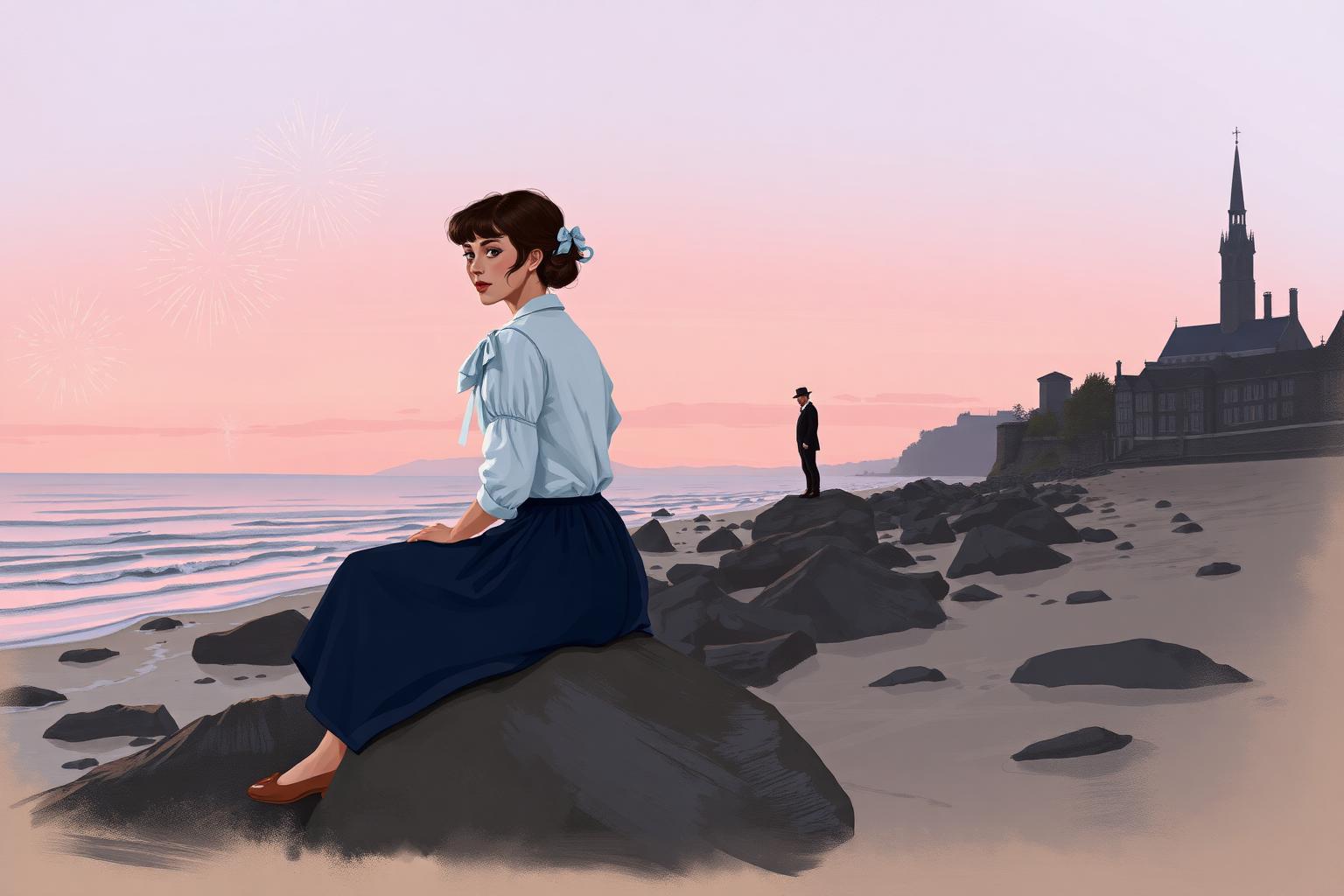
Painterly twilight scene of Sandymount Strand in Dublin: a young woman in a navy skirt and pale blouse sits on a rock looking out to sea, while in the distance the silhouette of Leopold Bloom stands alone on the sand watching her; fireworks bloom in the dusk above a church steeple.
Sandymount Strand · Twilight · 8 p.m.
Mirus Bazaar — Programme of Fireworks
Catherine wheels · Roman candles · O! O! O!
Ep. XIII · 16 vi 1904
Episode XIII · Nausicaa · Looking & Loneliness

Nausicaa: A Princess on the Rocks.

Episode 13 of Ulysses moves Homer's princess on the beach to Sandymount Strand at twilight, where Gerty MacDowell and a stranger named Bloom meet across the rocks without a single word — and the fireworks of the Mirus bazaar count down the chapter's choreographed climax.

"Tight boots? No. She's lame! O! Mr Bloom watched her as she limped away. Poor girl!"
Ulysses, Episode 13
L
Leopold Bloom
Washed up at evening
G
Gerty MacDowell
On the rocks, watching
O
Odysseus
Naked and salt-white
N
Nausicaa
Princess on the shore
Plain-English mode
Scroll to begin
§1 · Why "Nausicaa"?

A young woman, a tired man, a sky full of fireworks.

In Book 6 of the Odyssey, the shipwrecked Odysseus is washed up on the island of Scheria, naked and crusted with salt, and discovered on the beach by the king's daughter Nausicaa, who has come to do the washing with her maids. She does not flee; she gives him clothes and food and directs him to her father's palace. It is the Odyssey's gentlest meeting.

Joyce relocates the meeting to Sandymount Strand at evening. Nausicaa becomes Gerty MacDowell, a young Dublin girl on the rocks. Odysseus becomes Bloom, washed up at the day's lowest tide. The two never speak. They look. The Mirus bazaar fireworks rise over the bay; a Roman candle bursts; and the mythic moment of rescue becomes a small, mutual, unspoken act of seeing and being seen.

The Homeric beach becomes a Dublin strand, and the rescue is performed in silence.

  1. c. 8th c. BCE
    Homer's Odyssey
    Odysseus is found by Nausicaa on Scheria
  2. 1890s–1900s
    Penny-romance fiction in Dublin
    The magazines Gerty's narrative voice imitates
  3. 1904
    Mirus bazaar, Ballsbridge
    The real fundraising bazaar whose fireworks light the chapter
  4. 16 June 1904, ~8 p.m.
    Sandymount Strand
    Bloom and Gerty meet by looking and not by speech
  5. 1921
    Little Review prosecution
    Serialisation of this chapter brings the U.S. obscenity trial
  6. 1922
    Publication
    Ulysses appears in Paris
§2 · Odyssey Primer

Nausicaa in The Odyssey — in brief.

After his raft is smashed by Poseidon, Odysseus swims for two days and crawls naked onto the island of the Phaeacians. He sleeps under olive bushes. Meanwhile the goddess Athene visits the dreams of the king's daughter, Nausicaa, and prompts her to take the household linen down to the river-mouth to wash.

Nausicaa and her maids wash, eat, and play ball. Their shouts wake Odysseus. He emerges, covers himself with a branch, and speaks to her with such elaborate courtesy that she gives him clothes, food, and instructions for reaching her father's palace.

It is the Odyssey's quietest rescue — no monster, no violence — and one of its sweetest. Joyce keeps the register exactly: in Nausicaa, no one is hurt, and one very tired man is, briefly, treated kindly.

Beach
Ball
Wave
Spark
Cuckoo
§3 · How Homer becomes Dublin

Six transformations, from the river-mouth to the strand.

Homer
The mouth of the river on Scheria
Joyce
Sandymount Strand at evening

Odysseus washes up at the river-mouth where Nausicaa has come to do the washing with her maids. Joyce places his own washed-out hero on the rocks of Sandymount Strand — the same Dublin beach where Stephen walked in Proteus that morning — at the cool blue hour of evening. Two characters who would never meet in any drawing room are placed by Joyce on a strip of sand, with a sea-wall between them and nothing to do but look.

The summer evening had begun to fold the world in its mysterious embrace.
Ulysses, Episode 13 (opening)
strandeveningDublin
§4 · Who's Who

Homeric counterparts in Episode 13.

Nausicaa stages Sandymount Strand as Homer's beach — a strip of sand where two strangers meet by looking and never by speech.

UlyssesOdyssey counterpartNote
Leopold BloomOdysseus shipwreckedAt the day's lowest tide; saved by being looked at kindly
Gerty MacDowellNausicaaYoung, romantic, lame; the chapter's first voice
Cissy CaffreyNausicaa's bolder handmaidenLoud, hatless, runs barefoot on the sand
Edy BoardmanNausicaa's quieter handmaidenMinds the babies; cattily aware of Gerty
Tommy & Jacky, Baby BoardmanChildren at the river-mouthDomestic chaos around the mythic meeting
Father Conroy & Canon O'HanlonThe priests at Alcinous' palace (loose)Their benediction at Mary, Star of the Sea forms the chapter's antiphon
The Mirus bazaar fireworksThe ball thrown into the riverThe signal that wakes both characters into the moment
Linati Schema (1920)

Scene: The Rocks. Art: Painting. Symbol: Virgin. Technique: tumescence / detumescence.

Gilbert Schema (1921)

Organ: eye, nose. Colour: grey, blue. Hour: 8 p.m.

Homeric correspondences

Nausicaa → Gerty. Handmaidens → Cissy & Edy. Athene → cheap magazines. Ball → roman candle.

§5 · Key themes

Ten threads through the twilight beach.

The strand

Sandymount Strand: Stephen's morning beach revisited at evening.

Tumescence

Schema-technique: rhetorical swelling and collapse.

Magazine prose

Joyce's pitch-perfect parody of penny-romance style.

Voyeurism

A wordless, mutual exchange of looks across the rocks.

Mariolatry

The Virgin's service across the wall — sacred to the secular climax.

Fireworks

Mirus bazaar rockets timing the chapter's bodily moment.

Lameness

Gerty's leg revealed only at the parting; the chapter's pity-moment.

Cuckoo

A clock-cry naming Bloom's private grief three times.

Tenderness

One of Joyce's gentlest stretches of writing about Bloom.

Loneliness

Two strangers meet by not meeting — and are briefly, kindly, less alone.

§6 · Quotations & close reading

Homer beside Joyce.

Homer

"There by the river's side were the lovely washing-places, with abundance of clear water gushing up through, enough to cleanse the foulest garments."

Odyssey, Book VI (Butcher & Lang)

Joyce

"The summer evening had begun to fold the world in its mysterious embrace. Far away in the west the sun was setting and the last glow of all too fleeting day lingered lovingly on sea and strand."

Ulysses, Episode 13 (opening)

Why this matters

Homer's clean precise description of a real river-mouth becomes Joyce's deliberately swollen sunset prose — pastiche of every late-Victorian sentimental opener. The chapter announces from its first sentence that its setting will arrive through Gerty's borrowed style before it arrives through the world.

Homer

"She alone abode and faced him; for Athene put courage into her heart and took fear from her limbs."

Odyssey, Book VI (Nausicaa)

Joyce

"Gerty MacDowell who was seated near her companions, lost in thought, gazing far away into the distance was in very truth as fair a specimen of winsome Irish girlhood as one could wish to see."

Ulysses, Episode 13

Why this matters

Nausicaa's mythic courage is a brief Homeric line; Gerty's poise is a full magazine paragraph. Joyce keeps the gesture (a young woman holds her ground in a charged moment) and gives it the prose she would recognise herself in.

Homer

"Then with a mighty cast she sent the ball at one of the maidens, and missed her, and cast it into the deep eddying current."

Odyssey, Book VI

Joyce

"And then a rocket sprang and bang shot blind and O! then the Roman candle burst and it was like a sigh of O!"

Ulysses, Episode 13

Why this matters

The ball Nausicaa throws into the river is replaced by a Roman candle fired into the sky. Homer's accident becomes Joyce's choreography: the moment that wakes the hero is now exquisitely, almost embarrassingly, timed.

§7 · Modernity vs Epic

A gentle myth, rewritten in penny-romance prose.

Homer

River-mouth, clean linen, a ball

A princess and her maids do household work in the open air; a stranger appears; he speaks well; he is given clothes and sent on his way. The meeting is daylight, public, kind.

Joyce

Rocks, magazine prose, a roman candle

A girl sits with her friends and minds someone else's children; a stranger watches from a distance; nothing is said; a firework bursts; he sees she is lame. The meeting is dusk, private, gentle, and entirely unspoken.

Joyce keeps the kindness of the Homeric meeting and changes everything else — the clean linen becomes a magazine in the head, and the ball thrown into the river becomes a Roman candle in the sky.

§8 · Why this episode matters

The novel's most controversial chapter — and its most tender.

Nausicaa is the chapter that almost killed Ulysses: its serialisation in the Little Review in 1920 triggered the U.S. obscenity prosecution that banned the novel until Judge Woolsey's 1933 decision. Yet read on its own terms, it is one of Joyce's gentlest performances — a meeting in which no one is harmed, no one speaks, and two lonely people are, for a moment, less alone.

The Homeric meeting on the beach is the Odyssey's first moment of pure human kindness after the wandering. Joyce honours that exactly. The mythic rescue becomes a small act of being looked at without contempt, after a day that has offered Bloom funerals, sneers, and a thrown biscuit-tin. Even the cuckoo-clock that mocks him at the end is, in context, almost affectionate.

The hero washed up at the day's lowest tide is given, briefly, the kindest thing one stranger can give another: an unjudgmental look.

§9 · FAQ

Quick answers.

  • Joyce maps Episode 13 onto Book 6 of the Odyssey, in which the shipwrecked Odysseus, naked and crusted with salt, is discovered on a beach by the young princess Nausicaa and her handmaidens. Joyce calls his chapter 'Nausicaa' because Leopold Bloom — exhausted, mourning, washed up after the day's near-shipwrecks — encounters a young Dublin girl, Gerty MacDowell, on the rocks of Sandymount Strand at evening, and a wordless exchange of looks (and a discreet act of voyeurism timed to a fireworks display) becomes the chapter's modern restaging of that mythic meeting.