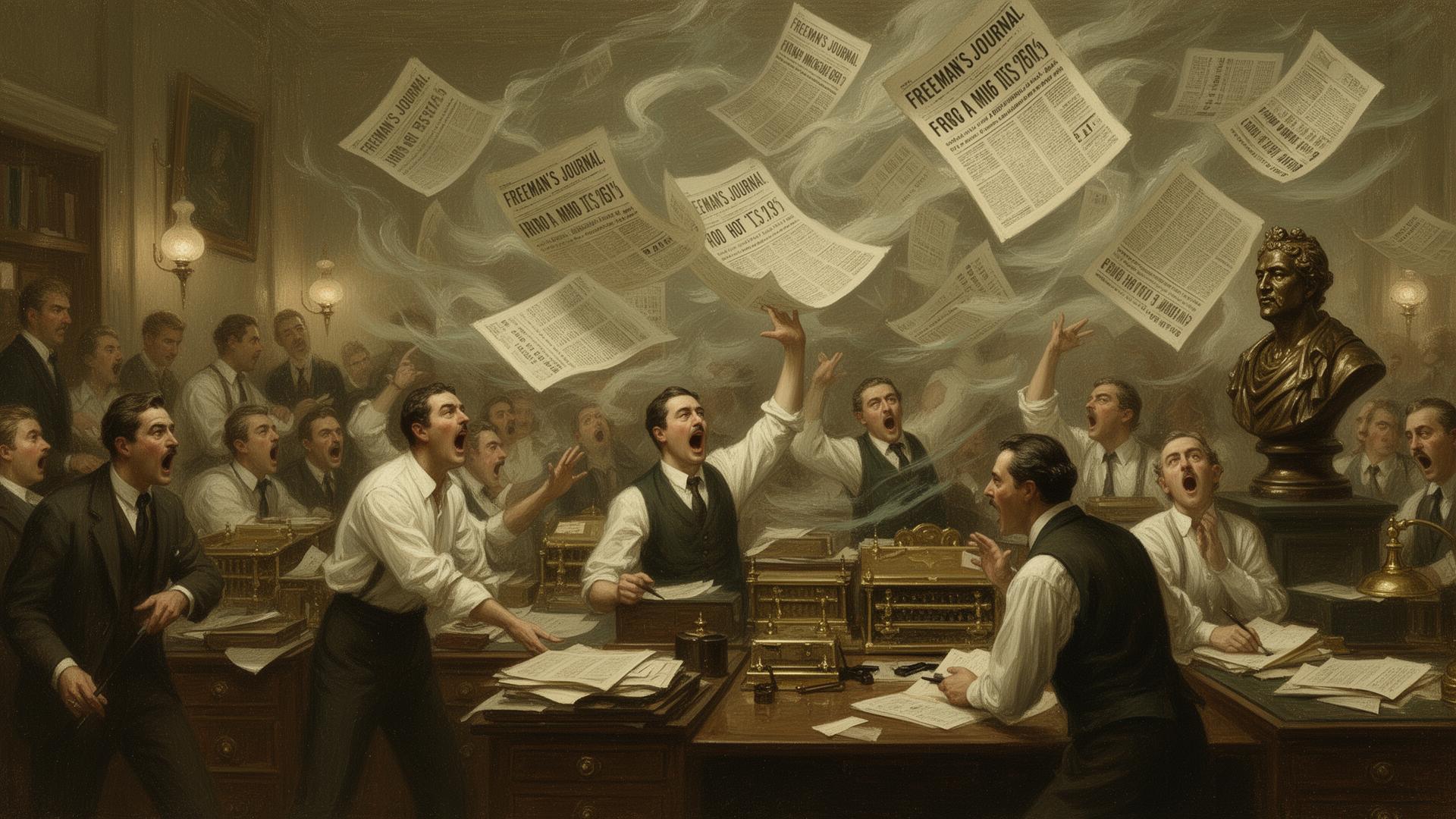
A bustling 1904 Dublin newsroom at the Freeman's Journal: editors shout across desks as broadsheet pages swirl into the air on a sudden gust of wind, beside a bronze bust — Joyce's Aeolus.
The Freeman's JournalVol. VII · Aeolus · 16 June 1904Episode VII
Aeolus · Rhetoric & the Wind of the City

Aeolus: A Newsroom Full of Wind.

Episode 7 of Ulysses moves Homer's island of breezes into the offices of the Freeman's Journal — and chops the prose itself into sixty-three gusty headlines that won't let the story sail.

"In the heart of the Hibernian metropolis."
Ulysses, Episode 7 (opening headline)
L
Leopold Bloom
Placing the Keyes ad
M
Myles Crawford
Editor, flush-faced
O
Odysseus
Asking for fair wind
A
Aeolus
Keeper of the winds
Plain-English mode
Scroll to begin
§1 · Why "Aeolus"?

The wind-god moved to Prince's Street.

In Book 10 of the Odyssey, Aeolus, keeper of the winds, gives Odysseus an ox-hide bag containing every contrary breeze, so that only a fair wind will blow him home. His crew, suspecting treasure, opens it within sight of Ithaca. The whole gale rushes out and drives them back.

Joyce relocates the wind-god to Dublin's foremost newspaper. The office is full of orators, sub-editors and hangers-on; the bag of winds is the sixty-three boldface headlines that punctuate the chapter. Every gust pushes the story off course and back toward the speaker's own throat.

The epic wind is rewritten as the modern public sphere.

  1. c. 8th c. BCE
    Homer's Odyssey
    Aeolus, the bag of winds, the second refusal
  2. 1763
    Freeman's Journal founded
    Dublin's leading nationalist paper
  3. 1901
    Taylor's speech on Moses
    The oration Joyce quotes in full
  4. 16 June 1904, ~12 noon
    Prince's Street
    Bloom in the newsroom; Stephen arrives with Deasy's letter
  5. 1921
    Headlines added
    Joyce inserts 63 headline-style sub-sections in proof
§2 · Odyssey Primer

Aeolus in The Odyssey — in brief.

After leaving the Cyclops, Odysseus and his crew reach Aeolia, a floating island ringed by a bronze wall. Aeolus, appointed by Zeus as keeper of the winds, hosts them for a month and listens to the long story of Troy.

On their departure he gives Odysseus a tightly sewn ox-hide bag holding the contrary winds, leaving only the West Wind to push them home. Ithaca is in sight when the crew, jealous, open the bag. The released gale drives them back to Aeolia, where the wind-god, deciding they are cursed, refuses to help again.

Book 10 is the Odyssey's parable of foolish curiosity and divine refusal — and Joyce takes it as his template for a chapter on public speech, where every gust of rhetoric blows the meaning further from its harbour.

Wind
Bag
Lungs
Press
Headline
§3 · How Homer becomes Dublin

Six transformations, from Aeolia to Prince's Street.

Homer
Aeolus, keeper of the winds
Joyce
Myles Crawford, editor of the Freeman's Journal

Homer's Aeolus is a hospitable king on a floating island who entertains Odysseus for a month and sends him off with a bag of useful winds. Joyce's Crawford is a flush-faced editor in a newspaper office on Prince's Street who entertains anyone willing to listen and sends Bloom off with nothing at all. The divine quartermaster of weather becomes a man who decides which advertisement runs on page three.

—K.M.A., Myles Crawford said, throwing a long swift glance at his readers. —Kiss my arse, he said.
Ulysses, Episode 7
rhetoriceditorshipthe city
§4 · Who's Who

Homeric counterparts in Episode 7.

Aeolus stages the Freeman's Journal as a floating bronze hall — and its windy editor as a wind-god who twice turns Bloom away.

UlyssesOdyssey counterpartNote
Myles CrawfordAeolusThe king of the windy hall — generous, then dismissive
The newsroom regularsAeolus' children / banquetersA closed company feeding on speech
Leopold BloomOdysseus on AeoliaThe visitor seeking favour, refused on the second approach
Lenehan, O'Madden Burke, MacHughOdysseus' crew opening the bagHangers-on whose gusts undo every effort
The headlinesThe bag of winds itselfEach one a contrary breeze loosed on the page
Stephen's plum parableA counter-song against epicAn anti-rhetorical fable; the deflating wind
Linati Schema (1920)

Scene: The Newspaper. Art: Rhetoric. Symbol: machines (the press) / Aeolus.

Gilbert Schema (1921)

Organ: lungs. Technique: enthymemic (rhetorical syllogism). Colour: red.

Homeric correspondences

Aeolus → Crawford. Bag of winds → the headlines. Foolish crew → the newsroom regulars.

§5 · Key themes

Ten threads through the windy noon.

Rhetoric

The chapter's named art: every register of public Irish speech.

Wind

Breeze, gust, lung, breath — the organ of the chapter is the lungs.

Journalism

Headlines, sub-eds, copy: the modern manufacture of public meaning.

Nationalism

Dan Dawson, Taylor, the new Israel — Irish rhetoric as Mosaic.

Empire

Crown, royal arse, English papers — colonial weather behind every speech.

Form

Sixty-three headlines turn the chapter into a self-conscious newspaper.

Bloom rebuffed

The hero is dismissed twice — the chapter's quiet humiliation.

Stephen vs Bloom

Father and son almost cross paths, do not meet — yet.

Trams & traffic

The city's own breath: trams, drays, mailcars at Nelson's Pillar.

Plumstones

The deflating image: spit and stones from the top of empire.

§6 · Quotations & close reading

Homer beside Joyce.

Homer

"He gave me a bag, made of the hide of an ox of nine years old, and in it he bound the paths of the blustering winds."

Odyssey, Book X (public domain trans.)

Joyce

"IN THE HEART OF THE HIBERNIAN METROPOLIS / Before Nelson's pillar trams slowed, shunted, changed trolley, started for Blackrock, Kingstown and Dalkey…"

Ulysses, Episode 7 (opening headline)

Why this matters

Homer's contrary winds, sealed in an ox-hide bag, are reborn as headlines sealed in heavy capitals. Each new heading lets a new gust into the chapter — and pushes the narrative off course.

Homer

"Then he raged in spirit and addressed me: 'Get thee gone from the island… for it may not be that I should give furtherance or escort to a man whom the blessed gods abhor.'"

Odyssey, Book X

Joyce

"—He can kiss my royal Irish arse, Myles Crawford cried loudly over his shoulder. Any time he likes, tell him."

Ulysses, Episode 7

Why this matters

The wind-god's solemn second refusal becomes a Dublin obscenity yelled down a corridor. Joyce keeps the gesture exactly — the door is shut on the hero — and detonates the register.

Homer

"Then would I have come, by speedy ship, even to my native land; but my comrades took counsel for evil among themselves."

Odyssey, Book X

Joyce

"—Onehandled adulterer, he said smiling grimly. That tickles me, I must say."

Ulysses, Episode 7

Why this matters

The hero's near-return undone by his crew becomes Stephen's anti-rhetorical wit undoing the orators. The plum parable that follows is Joyce's bag of winds, opened from below.

§7 · Setbacks & Frustrated Ambitions

Setbacks and Frustrated Ambitions in Aeolus.

Beneath the noise, rhetoric and bombast of the newspaper office runs a quieter but pervasive theme: failure. Throughout the episode almost every significant character meets a setback, a disappointment, or an inability to achieve what they came for.

The winds of Aeolus stand for movement and energy — yet they rarely propel anyone forward. Words, politics and promises circulate endlessly without producing meaningful results. The hall is loud; the harbour stays out of reach.

A great machine for making wind — and almost none of it fills a sail.

Setback 01

Bloom's Unpaid Debt

Bloom had previously lent money to Joe Hynes but is far too polite to press him for repayment, even when the chance arrives.

Bloom watched him stride off… Now if he got paid he'd come round. Three weeks. Will he? He can't.
Ulysses, Episode 7

SignificanceHynes passes the cashier's window with money owed to Bloom in his pocket, yet Bloom cannot bring himself to ask. His financial caution and inability to assert himself collide: generosity, once again, brings him no reward. It is one of Bloom's quiet, recurring personal defeats.

Setback 02

The Advertisement That Never Happens

Bloom comes to the office hoping to secure favourable placement for Alexander Keyes' advertisement — the day's one piece of real business.

—He wants it in for two months, Mr Bloom said… —Tell him he can kiss my arse, Myles Crawford said.
Ulysses, Episode 7

SignificanceDespite careful planning — the crossed-keys design, the renewal, the trip to the National Library for the motif — interruptions, mood and office politics defeat him. When Bloom leaves, the task is still unfinished. His patient practicality is no match for the journalists' verbosity.

Setback 03

Stephen's Mission Ends in Failure

Stephen faithfully delivers Mr Deasy's earnest letter on foot-and-mouth disease, discharging the errand begun in Nestor.

—Now he wants to write to the papers about it… We can do that, Myles Crawford said. Where is it? … I see, the editor said.
Ulysses, Episode 7

SignificanceCrawford skims and mocks the letter rather than embracing it; publication looks unlikely. Stephen's dutiful idealism meets the editor's cynicism, and journalism reveals itself as performance rather than public service.

Setback 04

A Barrister Reduced to Begging

J. J. O'Molloy, once a rising lawyer, quietly tries to ask Myles Crawford for financial help.

—Well? he said. — … J. J. O'Molloy… —Is the editor to be seen? he asked… A telephone rang rudely.
Ulysses, Episode 7

SignificanceHis request goes nowhere — interrupted, deflected, never quite spoken aloud. The scene dramatises his fall from professional success into dependency, and shows Joyce's recurring fascination with genteel decline.

Setback 05

The Perfect Reply Arrives Too Late

Bloom only later thinks of the cutting thing he should have said to John Henry Menton — a textbook case of esprit de l'escalier.

Could you tell me that I was thinking of… No. I should have said something about an old hat or something. No.
Ulysses (cf. Hades & Aeolus)

SignificanceBloom's insecurity and social awkwardness surface in the gap between thought and speech. The belated retort is one of Joyce's most psychologically realistic observations — interior consciousness running a beat behind the social world.

Setback 06

Talent That Never Flourished

O'Molloy is repeatedly described as a man of remarkable gifts who has failed to fulfil them.

J. J. O'Molloy's white careworn face… Cleverest fellow at the junior bar he used to be. Decline, poor chap.
Ulysses, Episode 7

SignificanceDrink, bad fortune and squandered ability have hollowed out a brilliant career. His unrealised potential is one of the novel's recurring themes — the gap between promise and achievement that shadows nearly everyone in the office.

Setback 07

A Newspaper in Decline

Beneath the bustle, the Freeman's Journal is an institution under commercial pressure, its circulation slipping.

—We were never loved but by foreigners… Lost in the abstruse… the smell of old printing-houses, dust and decay.
Ulysses, Episode 7 (paraphrase of office mood)

SignificanceCompetition, a changing readership and commercial pressure erode the paper even as its men declaim immortal speeches. The institutional setback rhymes with the personal failures unfolding inside it.

Circulation, trending down
Setback 08

Politics Set Back by Violence

The chapter's talk circles the 1882 Phoenix Park murders, carried out by the Invincibles, which damaged the constitutional nationalist cause.

—The Invincibles, he said, the new Messiah for Ireland! … Skin-the-Goat… drove the car for the getaway.
Ulysses, Episode 7

SignificanceCombined later with the Parnell split, the murders delayed Irish Home Rule for decades. The episode turns on unintended consequences and historical irony: rhetoric and violence both circulate, yet neither delivers the nation home.

From violence to a delayed state
  1. 1882
    Phoenix Park Murders
    Invincibles kill Cavendish & Burke
  2. 1890–91
    Parnell Crisis
    The split fractures the party
  3. 1893–1914
    Delayed Home Rule
    Bills blocked or suspended
  4. 1922
    Irish Free State
    Self-government, decades late
Concluding insight

Failure as the Hidden Wind of Aeolus.

Almost every narrative strand in the episode ends unsuccessfully:

  • Bloom fails to collect the money owed to him.
  • Bloom fails to secure the Keyes advertisement.
  • Stephen fails to advance Deasy's cause.
  • J. J. O'Molloy fails to obtain financial help.
  • O'Molloy's career has failed to fulfil its promise.
  • Bloom fails to say the right thing at the right time.
  • The Freeman's Journal struggles commercially.
  • Irish nationalism suffers historical reverses.

Joyce turns the bustling newspaper office into a metaphorical machine that generates noise rather than progress — where language circulates endlessly, but tangible achievement remains forever out of reach.

§8 · FAQ

Quick answers.

  • Joyce maps Episode 7 onto Book 10 of the Odyssey, where Aeolus, keeper of the winds, gives Odysseus a bag of breezes — which his crew opens too soon, blowing them back from home. Joyce calls his chapter 'Aeolus' because the Freeman's Journal newsroom is full of hot air: speeches, slogans, headlines, gusts of rhetoric that lift the city up and just as quickly let it drop.