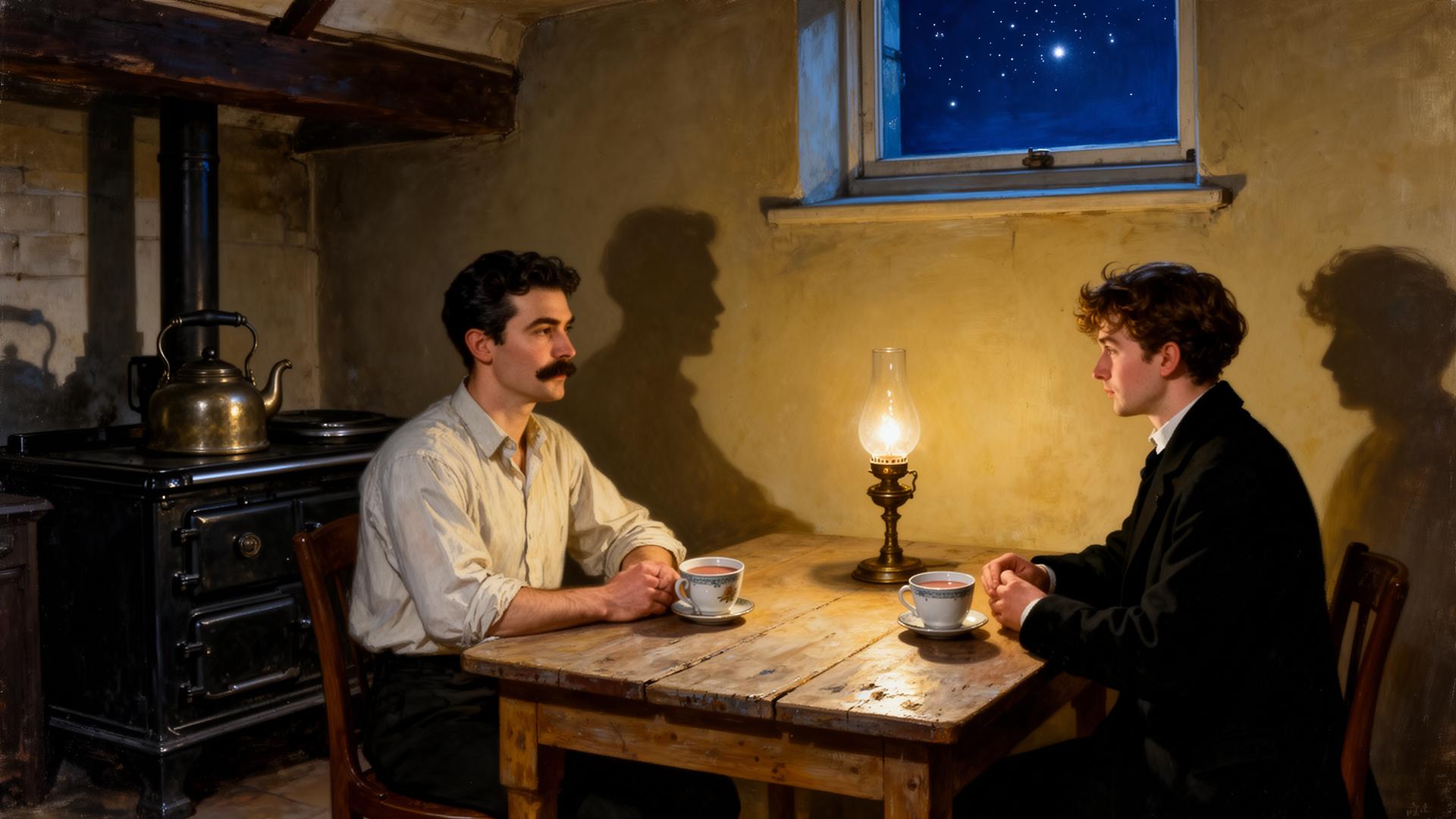
Painterly Edwardian Dublin basement kitchen at 7 Eccles Street, around 2 a.m.: Bloom in shirtsleeves and Stephen Dedalus in a black coat sitting opposite each other across a scrubbed wooden table with two cups of cocoa, mirrored by their shadows on the wall; starlight through a small high window.
7 Eccles Street · Kitchen · 2 a.m.
Catechism — A Homecoming in Q & A
Cocoa · Astronomy · The list · The bed · The dot
Ep. XVII · 17 vi 1904
Episode XVII · Ithaca · The Homecoming

Ithaca: A Homecoming as Mathematical Catechism.

Episode 17 of Ulysses moves Homer's slaughter of the suitors and the olive-tree bed into 7 Eccles Street at 2 a.m. — a kitchen, a garden under the stars, a brass bed, all rendered in the most radical prose experiment in the book: a calm, scientific, question-and-answer catechism. Joyce's own favourite chapter.

"Womb? Weary? He rests. He has travelled."
Ulysses, Episode 17 (closing)
L
Leopold Bloom
Returning householder
S
Stephen Dedalus
Departing guest
O
Odysseus
King returning home
P
Penelope
Waiting in the bed
Plain-English mode
Scroll to begin
§1 · Why "Ithaca"?

A palace, a kitchen, a catechism.

In Books 22–23 of the Odyssey, Odysseus kills the suitors of his wife, is recognised by Penelope through the secret of their marriage bed, and falls asleep beside her at last.

Joyce keeps the homecoming and changes almost every detail of its execution. The slaughter becomes a list; the recognition becomes a cup of cocoa; the bed becomes a brass bedstead Molly was born in; the embrace becomes a kiss at the foot of the bed; the language becomes the most experimental of the novel — a deadpan question-and-answer catechism that treats the height of a railing and the heat-death of the universe with the same level voice. Joyce called it his favourite chapter.

The homecoming arrives — and the prose insists on its ordinariness as a moral act.

  1. c. 8th c. BCE
    Homer's Odyssey
    Odysseus kills the suitors and lies down beside Penelope
  2. 1888
    7 Eccles Street
    The Joyce/Byrne address that becomes Bloom's home
  3. 17 June 1904, ~2 a.m.
    Eccles Street kitchen
    Cocoa, garden, bedroom — the homecoming proper
  4. 1921
    Drafted
    Joyce's favourite chapter to write
  5. 1922
    Publication
    Ulysses appears in Paris
§2 · Odyssey Primer

Ithaca in The Odyssey — in brief.

Reaching his palace at last, Odysseus and Telemachus, with the help of two faithful servants, bar the doors of the great hall and kill the suitors who have been consuming Penelope's substance for years.

Penelope, cautious after twenty years, tests Odysseus by ordering their bed moved out of the bedroom. He answers that the bed cannot be moved — its bedpost is a living olive tree, rooted in the floor. Only her husband could know this. She accepts him.

They go up to the rooted bed and Athena holds back the dawn so the night can be long enough. Joyce keeps the structure of return + recognition + bed and changes every modality.

§3 · How Homer becomes Dublin

Six transformations, from the palace to the kitchen.

Homer
Odysseus disguised, arriving at his palace
Joyce
Bloom keyless, climbing over the railings

Odysseus comes home disguised as a beggar to test his household. Bloom comes home having forgotten his key and is forced to climb the railings, drop into the basement area, and let Stephen in through the front door. The Homeric stratagem becomes a small comic indignity — and yet the meaning is the same: the master of the house is forced to re-enter his own home from outside.

Did he fall? By his body's known weight of eleven stone and four pounds in avoirdupois measure, as certified by the graduated machine for periodical self-weighing in the premises of Francis Froedman, pharmaceutical chemist of 19 Frederick street, north…
Ulysses, Episode 17
keyrailingreturn
§4 · Who's Who

Homeric counterparts in Episode 17.

Ithaca stages 7 Eccles Street as the homecoming palace — and treats every object in it with the seriousness Homer reserves for kings.

UlyssesOdyssey counterpartNote
Leopold BloomOdysseus at the thresholdForgotten key, climb over railings, cocoa in the kitchen, head at the foot of the bed
Stephen DedalusTelemachus departingAccepts cocoa, declines the bed, walks off into the small hours
Molly BloomPenelope in the marriage bedOff-stage but felt — the centre toward which the chapter moves
BoylanThe chief suitorPresent only as crumbs in the bed and as one name on a long list
The cocoaHomeric hospitalityPrepared with liturgical exactness — the chapter's quiet sacrament
The brass bedsteadThe olive-tree bedHeirloom from Molly's father in Gibraltar; the centre of the home
The closing dotSleep at lastJoyce demanded an oversized period — the chapter's final gesture
Linati Schema (1920)

Scene: The House. Art: Science. Symbol: Comets. Technique: Catechism (impersonal).

Gilbert Schema (1921)

Organ: skeleton. Colour: none. Hour: 2 a.m.

Homeric correspondences

Palace → 7 Eccles St. Suitors → a list. Olive bed → brass bedstead.

§5 · Key themes

Ten threads through the homecoming.

Catechism

Q&A format gives the homecoming the calm of a textbook.

Cocoa

The chapter's modest, exact sacrament.

Stars

Cosmic scale beside small bodies — the chapter's signature.

The list

Suitors enumerated, not slain.

The bed

Centre of the home, marked by Boylan's traces.

Non-violence

Joyce's most pacifist re-reading of an epic.

Head-to-foot

Bloom's strange, tender bedroom posture.

Sinbad

Nursery rhyme as falling-asleep music.

The dot

Joyce's most famous piece of punctuation.

Symmetry

Bloom and Stephen briefly mirrored in the kitchen.

§6 · Quotations & close reading

Homer beside Joyce.

Homer

"And the heart of the godlike Odysseus laughed, for he saw the bed standing there as he had built it."

Odyssey, Book XXIII

Joyce

"What did the first drawer unlocked contain? … Three typewritten letters, addressee, Henry Flower, c/o P.O. Westland Row…"

Ulysses, Episode 17

Why this matters

Homer's recognition is built around a secret carved bed. Joyce's modern recognition is built around the catalogue of a desk drawer — a household inventoried into knowing itself.

Homer

"Then bow-bearing Odysseus, having stripped off his rags, leapt upon the great threshold with the bow and the quiver full of arrows, and shot the suitors one by one."

Odyssey, Book XXII

Joyce

"If he had smiled why would he have smiled? To reflect that each one who enters imagines himself to be the first to enter whereas he is always the last term of a preceding series even if the first term of a succeeding one."

Ulysses, Episode 17

Why this matters

Homer's hero kills his rivals with a bow. Joyce's hero answers them with a sentence — the slaughter has migrated entirely into the chapter's cold, level mind.

Homer

"And the two went up to the place of their bed of old, glad to come together once more."

Odyssey, Book XXIII

Joyce

"He kissed the plump mellow yellow smellow melons of her rump … with obscure prolonged provocative melonsmellonous osculation."

Ulysses, Episode 17

Why this matters

Joyce keeps the embrace and reshapes its body: tender, slightly absurd, very specifically itself. Marriage as something you climb back into, even after it has been disturbed.

§7 · Modernity vs Epic

A palace homecoming, rewritten as a kitchen.

Homer

A bow, a slaughter, a secret bed

A king strings his bow, kills more than a hundred men, and proves his identity by knowing his bed is rooted in a tree. The homecoming is bloody and total.

Joyce

A cocoa, a list, a brass bedstead

A middle-aged advertising canvasser makes hot chocolate, names the men who have come before him without killing any of them, and lies down at the foot of the bed in deference and love. The homecoming is bloodless and total.

Joyce keeps every shape of the Homeric homecoming and changes the body of every action. The arrow becomes a sentence; the embrace becomes a kiss at the foot of the bed.

§8 · Why this episode matters

The novel's true homecoming — and Joyce's most radical form.

Ithaca is the chapter Joyce called his favourite. It is also the chapter in which Bloom, after a full day of being insulted, fantasised about, propositioned and walked around the city, finally lies down beside his wife — and does so with a kiss and without violence.

The catechism is not coldness; it is a moral form. By giving Boylan's crumbs and the stars the same level voice, Joyce shows a marriage that survives not because its facts are flattering but because they can be looked at without flinching. The most experimental chapter in the book is also its most tender.

A modern homecoming: knowing everything, killing no-one, and falling asleep at the foot of the bed.

§9 · FAQ

Quick answers.

  • Joyce maps Episode 17 onto Books 22–23 of the Odyssey, in which Odysseus, having reached his palace on Ithaca, kills the suitors, is recognised by Penelope through the secret of their bed, and finally lies down beside her. The Joycean equivalent is Bloom's arrival home at 7 Eccles Street with Stephen Dedalus at around 2 a.m.: a return home, the contemplation of an unfaithful marriage bed, and a quiet rather than violent restoration of order.