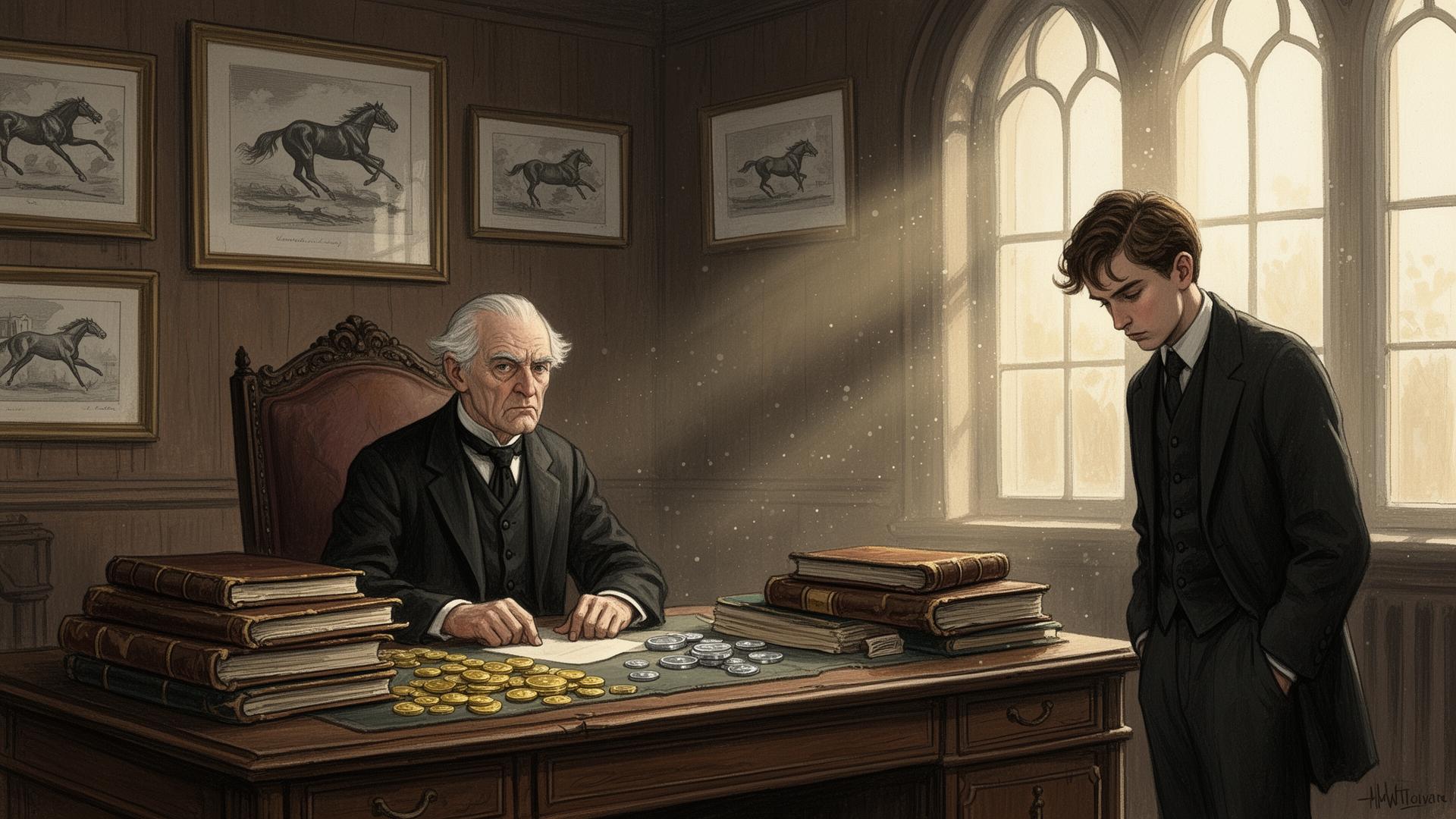
An Edwardian Dublin schoolroom dissolving into the columned palace of Nestor at Pylos, chalk dust and sea mist mingling in afternoon light.
Episode II · Nestor · History & Authority

Nestor: Joyce's Meditation on History and Authority.

Episode 2 of Ulysses transforms Homer's wise old king into a meditation on memory, power, nationalism, money and the burden of inherited ideas.

"History, Stephen said, is a nightmare from which I am trying to awake."
Ulysses, Episode 2
S
Stephen Dedalus
Sceptical young teacher
M
Mr Deasy
The headmaster
N
Nestor
King of Pylos
T
Telemachus
Son of Odysseus
Plain-English mode
Scroll to begin
§1 · Why "Nestor"?

Heroic wisdom, rewritten as a headmaster's lecture.

Joyce names Episode 2 after Nestor, the oldest of Homer's kings — the figure who, in the Odyssey, embodies memory, counsel and the continuity of generations. Telemachus visits him for news of his missing father, and Nestor responds with hospitality and long, looping recollections of the Trojan War.

Joyce reimagines that role in Mr Deasy, the headmaster of a small Dalkey school where Stephen Dedalus reluctantly teaches. Unlike Homer's noble elder, Deasy is narrow, prejudiced, and trapped in outdated thinking. The Homeric scene survives — old man, young man, the room of instruction — but its moral centre has rotted.

Joyce transforms heroic wisdom into the exhausted rhetoric of modern history.

  1. c. 1200 BCE
    Trojan War
    The mythic backdrop Nestor remembers
  2. c. 8th c. BCE
    Homeric Greece
    The Odyssey composed
  3. 16th–19th c.
    Colonial Ireland
    The history pressing on Stephen
  4. 16 June 1904
    Dalkey, Dublin
    Stephen teaches and quits
  5. 1922
    Publication
    Ulysses appears in Paris
§2 · Odyssey Primer

Nestor in The Odyssey — in brief.

In Book 3 of the Odyssey, Telemachus sails from Ithaca to Pylos in search of his father. He is welcomed by Nestor — the oldest of the surviving Greek kings — who pours libations, offers hospitality, and shares his memories of the years after Troy.

Nestor speaks of Agamemnon's terrible homecoming, of Menelaus's long wanderings, and of Odysseus's silence. He cannot give Telemachus the news he wants, but he gives him something else: an inheritance of memory, and the courage to keep looking.

The episode is about transmission. Knowledge passes from elder to younger; the past is poured, like wine, from one generation into the next. It is the calm before the long search begins in earnest.

Kingship
Memory
Storytelling
Wisdom
War
§3 · How Homer becomes Dublin

Six transformations, from Pylos to Dalkey.

Homer
Nestor, king of Pylos
Joyce
Mr Deasy, headmaster

Nestor is the noble old counsellor who welcomes Telemachus and pours out memory and advice. Joyce's Deasy occupies the same chair — the elder lecturing the young man — but his wisdom has soured into prejudice. He hectors Stephen about money, the English crown, and 'the jews', mistaking opinion for insight.

Mark my words, Mr Dedalus, he said. England is in the hands of the jews.
Ulysses, Episode 2
authorityprejudiceinherited power
§4 · Who's Who

Homeric counterparts in Episode 2.

Joyce's Homeric parallels operate symbolically and psychologically rather than through direct one-to-one equivalence.

UlyssesOdyssey counterpartNote
Stephen DedalusTelemachusSearching intellectual son
Mr DeasyNestorElder authority figure
The schoolboysYoung princes of PylosThe next generation, half-listening
Deasy's schoolPylosPlace of instruction and inherited order
Stephen's history lessonNestor's oral recollectionsTransmission of cultural memory
Deasy's coinsThe feast at PylosHospitality reduced to transaction
Linati Schema (1920)

Scene: the school. Art: history. Symbol: the horse.

Gilbert Schema (1921)

Scene: school. Organ: none. Technique: catechism (personal).

Homeric correspondences

Nestor → Deasy. Pisistratus → Sargent. Helen → Mrs O'Shea (alluded).

§5 · Key themes

Ten threads pulled from one short chapter.

History

The chapter's keyword — a nightmare for Stephen, a textbook for Deasy.

Memory

Homeric oral memory becomes Dublin's stale recitation of dates.

Authority

Who has the right to instruct? Joyce questions every elder in the room.

Colonialism

Ireland under empire shadows every confident sentence Deasy speaks.

Anti-Semitism

Deasy's prejudice exposes how 'wisdom' can carry poison forward.

Money

Hospitality becomes wages; relationships become accounts.

Generational conflict

The young decline to inherit the world the old hand down.

Education

The schoolroom is where ideology is quietly transmitted.

Paralysis

Joyce's lifelong Dublin diagnosis: a city that cannot move.

Wisdom vs pedantry

Heroic counsel hardens into the rhetoric of a headmaster.

§6 · Quotations & close reading

Homer beside Joyce.

Homer

"Then the Gerenian horseman Nestor answered him: 'Dear child, since indeed you bring back to my mind the sorrow we endured in that country…'"

Odyssey, Book III (public domain trans.)

Joyce

"— The ways of the Creator are not our ways, Mr Deasy said. All human history moves towards one great goal, the manifestation of God."

Ulysses, Episode 2

Why this matters

Nestor's memory is personal, grief-stained, particular. Deasy's 'history' is abstract, providential and politically convenient. Joyce sets them side by side to expose what modern authority has lost.

Homer

"Sleep, son of Atreus; it does not befit a counsellor to sleep all night through…"

Odyssey, Book III

Joyce

"— History, Stephen said, is a nightmare from which I am trying to awake."

Ulysses, Episode 2

Why this matters

Where the Homeric elder is wakeful and watchful, Stephen reframes wakefulness itself as a desperate escape from the dream of the past.

Homer

"Strangers, who are you? From where do you sail the watery ways?"

Odyssey, Book III — the welcome at Pylos

Joyce

"Mr Deasy took the coins from the drawer one by one… Two, he said. Two and twelve. Mark you, Mr Dedalus."

Ulysses, Episode 2

Why this matters

The Homeric welcome is a question; Deasy's welcome is a sum. Hospitality becomes accountancy.

§7 · Modernity vs Epic

The frame of epic, the weather of modernity.

Homer

Heroic continuity

Nestor's storytelling assumes a coherent world: gods watch, deeds matter, memory carries forward. The young man listens because the old man has something to give.

Joyce

Fragmentation & uncertainty

Deasy's confidence is ideological, not earned. Stephen receives wages and a letter and walks out into a city where no single voice can speak for the whole.

Joyce preserves the structure of epic while exposing the instability of modern identity and authority.

§8 · Why this episode matters

Where Telemachus ends, Nestor deepens.

"Nestor" deepens the father–son theme introduced in "Telemachus". Stephen has left the tower; now he leaves the schoolroom too. Each refusal narrows his world but clarifies his stance: he will not inherit on Deasy's terms.

History itself becomes one of the novel's central antagonists. Joyce critiques nationalism, empire, anti-Semitism and the cultural paralysis of Edwardian Dublin — and he does so without ever stepping outside a single small classroom.

In Joyce's Dublin, wisdom survives — but often in damaged or distorted forms.

§9 · FAQ

Quick answers.

  • Joyce built Ulysses on a Homeric scaffolding, and Episode 2 corresponds to the Telemachus-at-Pylos scene in Book 3 of the Odyssey. Joyce calls the chapter 'Nestor' because Mr Deasy, the headmaster who lectures Stephen on history and money, ironically occupies the role of Homer's wise elder.