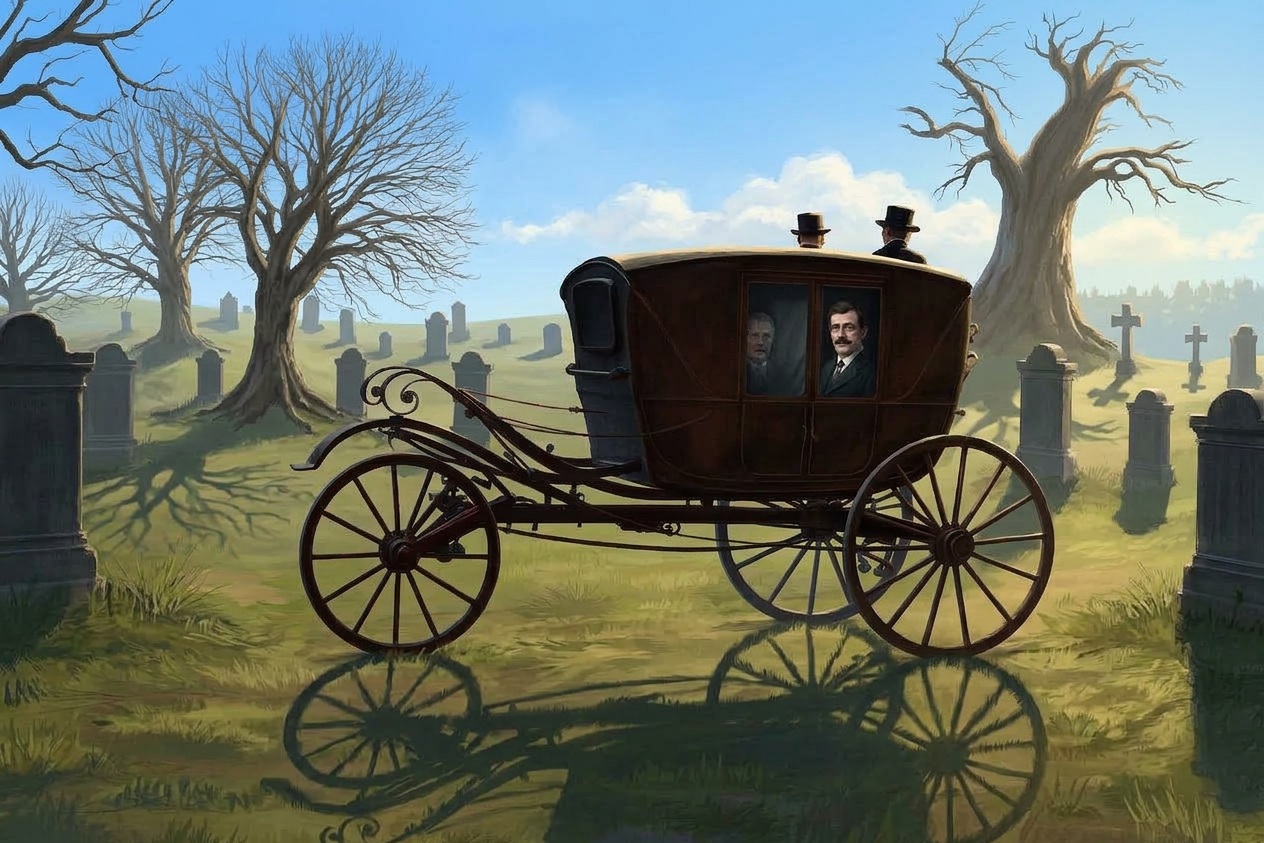
A black Edwardian funeral carriage moving through misty Glasnevin Cemetery, the silhouettes of the Greek underworld rising behind it.
Episode VI · Hades · Mourning & the Modern Underworld

Hades: Joyce's Descent into the Dublin of the Dead.

Episode 6 of Ulysses turns Homer's land of shades into a hired carriage to Glasnevin, where Bloom mourns Paddy Dignam in public and his own father and son in silence.

"Plenty to see and hear and feel yet. They are not going to get me this innings."
Ulysses, Episode 6
L
Leopold Bloom
Silent mourner
M
Martin Cunningham
Sympathetic friend in the carriage
O
Odysseus
Descender into the dead
T
Tiresias
Shade with the prophecy
Plain-English mode
Scroll to begin
§1 · Why "Hades"?

A land of shades, a hired carriage.

In Book 11 of the Odyssey, Odysseus sails to the edge of the world, digs a pit, pours libations of milk, honey, wine and blood, and summons the dead. He speaks with his comrade, with the prophet Tiresias, and — most painfully — with his mother Anticleia, who died of grief in his absence.

Joyce moves the underworld to north Dublin. Bloom rides in a funeral carriage to Glasnevin Cemetery for the burial of Paddy Dignam. Around him, the official rite of mourning unfolds. Inside him, two unburied losses — his father, a suicide; his infant son — rise to be addressed in silence.

The epic descent is rewritten as the modern grief one carries into other people's funerals.

  1. c. 8th c. BCE
    Homer's Odyssey
    Book 11 — the Nekyia
  2. 1832
    Glasnevin Cemetery founded
    Catholic burial ground for Dublin
  3. 1886
    Death of Rudolph Bloom
    Bloom's father's suicide in Ennis
  4. 16 June 1904, 11 a.m.
    Dignam's funeral
    Sandymount → Prospect Cemetery
  5. 1922
    Publication
    Ulysses appears in Paris
§2 · Odyssey Primer

The Nekyia in The Odyssey — in brief.

On Circe's instruction, Odysseus sails to the edge of Ocean, where the cimmerian people live in perpetual twilight. There he digs a pit, pours libations and sacrifices black sheep so that the dead may rise and drink.

He speaks first with Elpenor, his unburied crewman, then with Tiresias the prophet, who tells him of the journey home and the long suffering ahead. Then his mother's shade comes forward — and three times he reaches to embrace her, and three times she slips through his arms 'like a shadow or a dream'.

Book 11 is the Odyssey's most tender chapter: the hero confronts what death actually is — the loss of touch, of speech, of the warm body of the beloved.

Hearse
Grave
Heart
Canal
Soil
§3 · How Homer becomes Dublin

Six transformations, from Erebus to Glasnevin.

Homer
Odysseus rowing to the river of the dead
Joyce
The funeral carriage to Glasnevin

Odysseus crosses Ocean and lands at the dim grove of Persephone. Bloom rides a hired carriage from Sandymount across the city to Prospect Cemetery, passing the four civic monuments of Dublin like landmarks on the river Styx. The mythic descent becomes a mundane northward drive.

The wheels rattled rolling over the cobbled causeway and the crazy glasses shook rattling in the doorframes.
Ulysses, Episode 6
journeythe cityritual
§4 · Who's Who

Homeric counterparts in Episode 6.

Hades has Joyce's densest Homeric mapping in the early book: every mourner, every gate, every monument has an underworld counterpart.

UlyssesOdyssey counterpartNote
Leopold BloomOdysseus in HadesThe living visitor among the dead
Paddy DignamElpenor (the recent, unburied dead)The freshly dead whose body must be put away
Rudolph Bloom (father)Anticleia (Odysseus's mother)The unbidden parental shade
Rudy Bloom (infant son)Unfulfilled future / the unbornJoyce's private addition: the child who never lived to die
The man in the macintoshTiresiasThe mysterious figure at the threshold, who refuses to be read
John O'Connell, caretakerCharon / Hades's officialsThe professional gatekeeper of the dead
Glasnevin CemeteryErebus / Persephone's groveThe geography of the underworld, in north Dublin
Linati Schema (1920)

Scene: The Graveyard. Art: Religion. Symbol: the caretaker.

Gilbert Schema (1921)

Organ: heart. Technique: Incubism. Colour: white / black.

Homeric correspondences

Odysseus → Bloom. Anticleia → Rudolph & Rudy. Tiresias → M'Intosh.

§5 · Key themes

Ten threads through the cemetery.

Mourning

Public ritual vs. private grief — the chapter's twin engines.

Fatherhood

Bloom's father (lost) and son (never grown) — the absent line.

The body

Corpses, coffins, gas, decomposition — Joyce's unflinching realism.

Antisemitism

The carriage as Dublin in miniature; Bloom listens, says nothing.

Memory

Each landmark on the route is a private commemorative trigger.

The everyday

Hearses, prices, weather — death framed by errands.

Ethics

'They are not going to get me this innings.' A choice for life.

Religion

Father Coffey, the wafer-Latin, the inadequacy of the rite.

Mystery

M'Intosh: the figure who appears and is never explained.

Class & community

Whip-rounds, the widow's pension, who pays for the dead.

§6 · Quotations & close reading

Homer beside Joyce.

Homer

"Then there gathered from out of Erebus the spirits of those who are dead, brides and unwedded youths and toil-worn old men, and tender maidens with hearts yet new to sorrow."

Odyssey, Book XI (public domain trans.)

Joyce

"How many! All these here once walked round Dublin. Faithful departed. As you are now so once were we."

Ulysses, Episode 6

Why this matters

Homer's catalogue of shades becomes Joyce's quiet count of a Dublin cemetery. The Nekyia's poetic accumulation is rewritten as a single Bloomian thought — democratic, ironic, tender.

Homer

"Then came the spirit of my dead mother, Anticleia, daughter of great-hearted Autolycus, whom I had left alive when I departed for sacred Ilios. At the sight of her I wept, and my heart was filled with pity."

Odyssey, Book XI

Joyce

"If little Rudy had lived. See him grow up. Hear his voice in the house. Walking beside Molly in an Eton suit."

Ulysses, Episode 6

Why this matters

Joyce inverts Homer's mother-meeting: instead of the parent dead, the child dead — and instead of a real shade, an unrealised future. The Homeric grief of a son becomes the modern grief of a father.

Homer

"Then I said to her: 'Mother, why dost thou not abide me when I would clasp thee, that even in Hades we two may cast our arms each about the other?'"

Odyssey, Book XI

Joyce

"Plenty to see and hear and feel yet. Feel live warm beings near you. Let them sleep in their maggoty beds. They are not going to get me this innings."

Ulysses, Episode 6

Why this matters

Where Odysseus reaches forward and embraces emptiness, Bloom turns his back on the cemetery and chooses the warm and the present. Joyce reverses Homer's gesture: the modern hero saves himself by walking out.

§7 · Modernity vs Epic

Heroic descent, rewritten as a hired hearse.

Homer

Sacred geography

The hero sails to the edge of the world, performs blood-rites, and converses face to face with the named dead. The underworld is elsewhere.

Joyce

Civic geography

The hero takes a carriage up the Liffey, past the canal, to a municipal cemetery, and converses with the dead in his head. The underworld is on the bus route.

The descent is no longer geographical — it is the daily, civic weight of carrying one's dead through a working morning.

§8 · Why this episode matters

Bloom becomes the novel's secret centre.

Hades is where readers first learn what Bloom carries — his dead son, his suicide father — and what kind of attention he pays to other people's grief. The chapter is the moral hinge of the book.

It is also where the Homeric correspondence reaches its first full elaboration: the carriage as the boat to Hades, the caretaker as Charon, the strange mourner as Tiresias. After this chapter the parallels become a permanent grammar underneath the prose.

Bloom enters Hades a kind man. He leaves it a quietly heroic one.

§9 · FAQ

Quick answers.

  • Joyce maps Episode 6 onto Book 11 of the Odyssey — the Nekyia, Odysseus's descent to the land of the dead. The chapter follows Bloom in a carriage to Paddy Dignam's funeral and through the gates of Glasnevin Cemetery. Joyce calls it 'Hades' because Bloom literally and figuratively goes down among the dead.