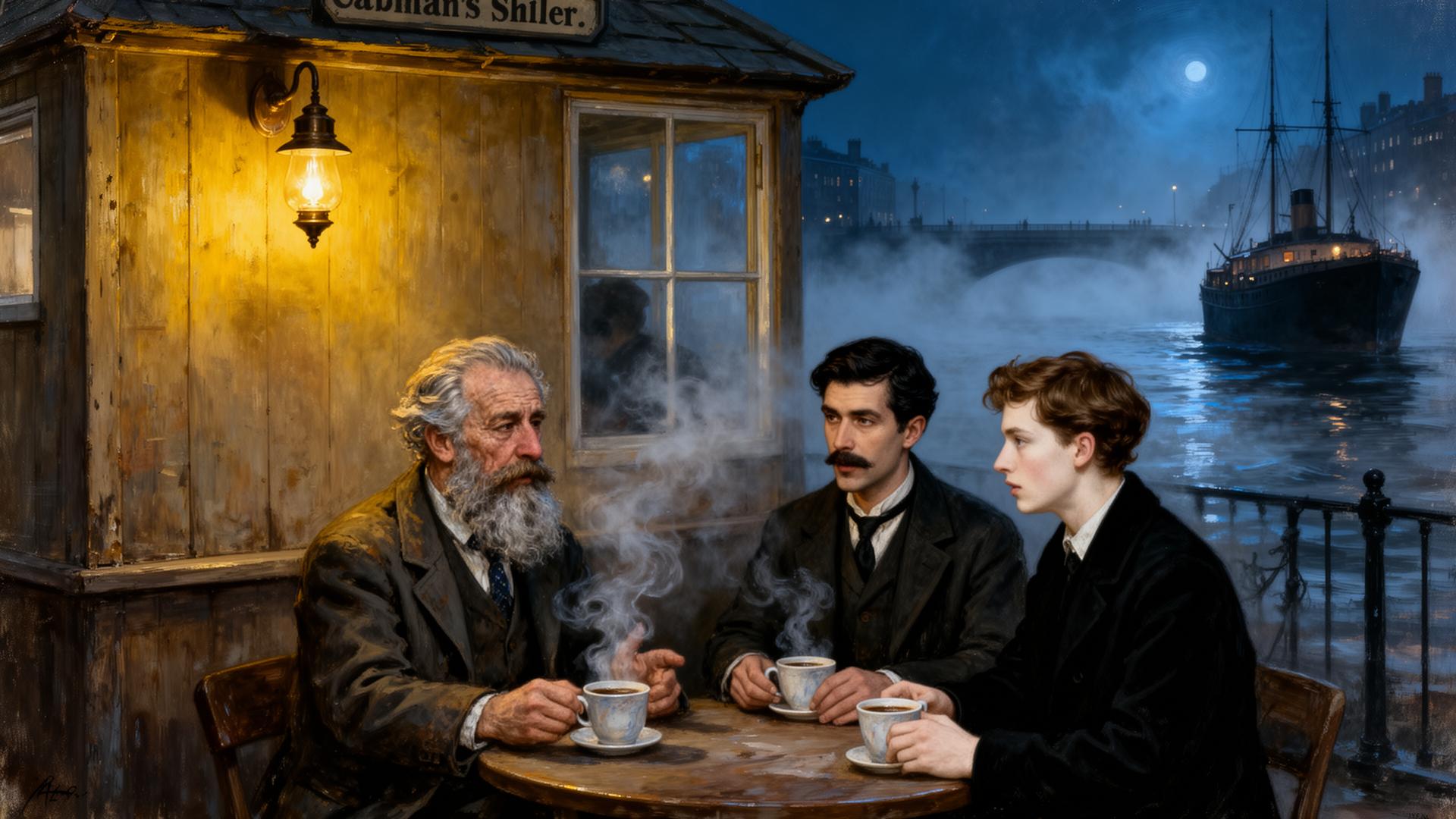
Painterly Edwardian Dublin night scene at the cabman's shelter near Butt Bridge: a small wooden hut lit by a single lamp, steam rising from coffee cups, an old grey-bearded sailor telling tall tales across the table from a tired Bloom and a pale young Stephen.
Cabman's Shelter · Butt Bridge · 1 a.m.
Bill of Fare — Coffee, Bun, Tall Tales
Yarns of Crete · Of Egypt · Of one Mr Bloom's wife
Ep. XVI · 17 vi 1904
Episode XVI · Eumaeus · The Shelter at 1 a.m.

Eumaeus: Two Men, a Sailor, and a Cup of Coffee.

Episode 16 of Ulysses moves Homer's swineherd's hut into a tin-roofed cabman's shelter near Butt Bridge — where Bloom takes the exhausted Stephen for coffee, listens to an old sailor's improbable yarns, and finally, quietly, walks the young man home.

"Preparatory to anything else Mr Bloom brushed off the greater bulk of the shavings and handed Stephen the hat and ashplant and bucked him up generally in orthodox Samaritan fashion."
Ulysses, Episode 16 (opening)
L
Leopold Bloom
Returning householder
W
W. B. Murphy
Yarn-spinning sailor
O
Odysseus
Returning king, disguised
E
Eumaeus
Faithful swineherd
Plain-English mode
Scroll to begin
§1 · Why "Eumaeus"?

A swineherd's hut, a cabman's shelter.

In Books 14–15 of the Odyssey, the disguised Odysseus shelters with his old swineherd Eumaeus, tells false but consoling stories of his life, and is finally reunited with his son Telemachus under the swineherd's roof.

Joyce moves the shelter to a real Dublin institution — a small tin-roofed cabman's shelter near Butt Bridge — and turns the long Homeric evening into the dog-end of a night. Bloom shepherds the exhausted Stephen in for coffee, listens to a yarn-spinning sailor named Murphy, shows Stephen a photograph of Molly, and walks him out toward Eccles Street. The chapter's prose is deliberately tired; the chapter's heart is the quiet completion of the father-son plot.

The Homeric reunion happens, but at one in the morning, over instant coffee.

  1. c. 8th c. BCE
    Homer's Odyssey
    Odysseus shelters with Eumaeus and tells false tales
  2. 1882
    Phoenix Park murders
    Skin-the-Goat, future shelter-keeper, was the getaway driver
  3. 17 June 1904, ~1 a.m.
    Cabman's shelter, Butt Bridge
    Bloom takes Stephen for coffee
  4. 1921
    Drafted
    Joyce wrote the chapter quickly after Circe
  5. 1922
    Publication
    Ulysses appears in Paris
§2 · Odyssey Primer

Eumaeus in The Odyssey — in brief.

Returning to Ithaca after twenty years, Odysseus is disguised by Athena as an old beggar and sent first to the hut of his faithful swineherd Eumaeus. Eumaeus does not recognise him but welcomes him as a guest.

They eat, drink and talk for two long evenings. Odysseus invents a long false life story — that he is a Cretan, exiled, robbed in Egypt — and Eumaeus listens patiently and disbelieves most of it but stays kind.

Telemachus, just back from his own travels, joins them. Father and son recognise each other in the hut and embrace; they plan the killing of the suitors. The hut is the threshold of the homecoming.

§3 · How Homer becomes Dublin

Six transformations, from Ithaca to Butt Bridge.

Homer
Eumaeus' rough hut on Ithaca
Joyce
The cabman's shelter near Butt Bridge

Homer's Eumaeus is a faithful slave who keeps his pigs and his hut on the edge of his master's land. Joyce's equivalent is a real Dublin institution: a tin-roofed cabman's shelter run, in legend, by the ex-Invincible 'Skin-the-Goat' Fitzharris, where cab-drivers and night-walkers could buy cheap coffee. The hero of antiquity takes his rest in the most humble urban shelter the modern city has to offer.

Preparatory to anything else Mr Bloom brushed off the greater bulk of the shavings and handed Stephen the hat and ashplant and bucked him up generally in orthodox Samaritan fashion.
Ulysses, Episode 16 (opening)
shelterSkin-the-Goatrest
§4 · Who's Who

Homeric counterparts in Episode 16.

Eumaeus stages a cabman's shelter as Homer's threshold of homecoming — the quietest, kindest chapter in Ulysses.

UlyssesOdyssey counterpartNote
Leopold BloomOdysseus as householderThe real returning man — quiet, kind, leading Stephen toward home
W. B. MurphyOdysseus as teller of tall talesImplausible sailor stories — Joyce's mock-Odysseus
Skin-the-Goat FitzharrisEumaeusShelter-keeper; ex-Invincible, links the chapter to Irish history
Stephen DedalusTelemachus arrivingExhausted, barely speaking, quietly accepting Bloom's company
The photograph of MollyPenelope at homeBloom's small awkward advertisement of his wife
The cabman's shelterThe swineherd's hutThe most humble shelter the modern city offers
Cab-drivers, dockersEumaeus' workersWitnesses at the edges, listening to Murphy's yarns
Linati Schema (1920)

Scene: The Shelter. Art: Navigation. Symbol: Sailors. Technique: Narrative (old).

Gilbert Schema (1921)

Organ: nerves. Colour: none. Hour: 1 a.m.

Homeric correspondences

Eumaeus → Skin-the-Goat. Odysseus → split between Bloom and Murphy.

§5 · Key themes

Ten threads through the small hours.

Fatigue

Both characters and prose are past tired.

Tall tales

Murphy's yarns echo Odysseus' lies in Homer.

Paternity

The Bloom-Stephen bond settles, quietly.

Cliché

Joyce makes worn-out language a precision instrument.

Coffee

The chapter's modest sacrament.

Ireland

Skin-the-Goat layers nationalist history into the parallel.

Photograph

Bloom's awkward advertisement of Molly.

Walking home

The chapter ends pointing at Eccles Street.

Disguise

Two characters performing 'Odysseus' on the same stage.

Kindness

The chapter's quiet moral content.

§6 · Quotations & close reading

Homer beside Joyce.

Homer

"He told her a tale, very like the truth, of how he had wandered far from the land of Crete; and she listened, but he did not deceive her."

Odyssey (paraphrase from Odysseus' lies)

Joyce

"Mr Bloom, without evincing surprise, unostentatiously turned over the photo so that its face might come more into the light."

Ulysses, Episode 16

Why this matters

Homer's listener half-believes, half-doesn't, and stays kind. Bloom adopts the same posture toward Murphy, and the chapter quietly approves of him for it.

Homer

"But come now, my swineherd, tell me of your master — whether he still lives, or is dead."

Odyssey, Book XIV

Joyce

"—You couldn't sleep at home? said Mr Bloom. Stephen, who had been hitherto silent, gave a vague reply."

Ulysses, Episode 16

Why this matters

Homer's reunion-question is grand and dynastic; Joyce's is small, paternal, kitchen-table. The chapter consistently shrinks epic questions into domestic ones.

Homer

"Then father and son rose and went forth from the hut, toward the city."

Odyssey, Book XVI

Joyce

"Side by side Bloom, profiting by the contretemps, with Stephen passed through the gap of the chains."

Ulysses, Episode 16 (closing)

Why this matters

Same gesture, smaller scale. Joyce trusts the reader to feel the Odyssean weight under the very plain Dublin sentence.

§7 · Modernity vs Epic

A swineherd's hut, rewritten as a tin shelter.

Homer

Wine, roast pig, a long evening

A king in disguise eats with a faithful retainer, tells a beautiful lie, and is reunited with his son. The reunion is the centre of the homecoming plot.

Joyce

Coffee, a bun, a tired conversation

An ad-canvasser buys an exhausted young poet a cup of coffee, listens to a stranger's tall tales, shows a photograph of his wife, and walks the young man home. The reunion is hidden inside ordinary kindness.

Joyce keeps the threshold of homecoming and changes its weather: instead of fire-lit feast, instant coffee and a yawn.

§8 · Why this episode matters

The chapter where the novel takes off its boots.

Eumaeus is the chapter that follows Circe's hallucinatory firework display, and Joyce knows exactly what he is doing by writing it tired. After the explosion comes the conversation; after the conversation comes the walk home.

It is also the chapter that quietly settles the Bloom-Stephen plot. There will be no grand recognition scene — there is only a cup of coffee, a photograph passed across a table, and two men walking up Gardiner Street together. Joyce believed the modern hero is the man who is kind at one in the morning.

The Homeric reunion happens, in the end, the way most actual reunions happen: late, tired, and over coffee.

§9 · FAQ

Quick answers.

  • Joyce maps Episode 16 onto Books 14–15 of the Odyssey, in which the disguised Odysseus, returning to Ithaca after twenty years, takes shelter in the hut of his old swineherd Eumaeus and listens to a long evening of tall tales before revealing himself. The Joycean equivalent is the cabman's shelter near Butt Bridge, where Bloom takes the exhausted Stephen for coffee and listens to a weather-beaten old sailor — W. B. Murphy — spin maritime yarns of doubtful truth.