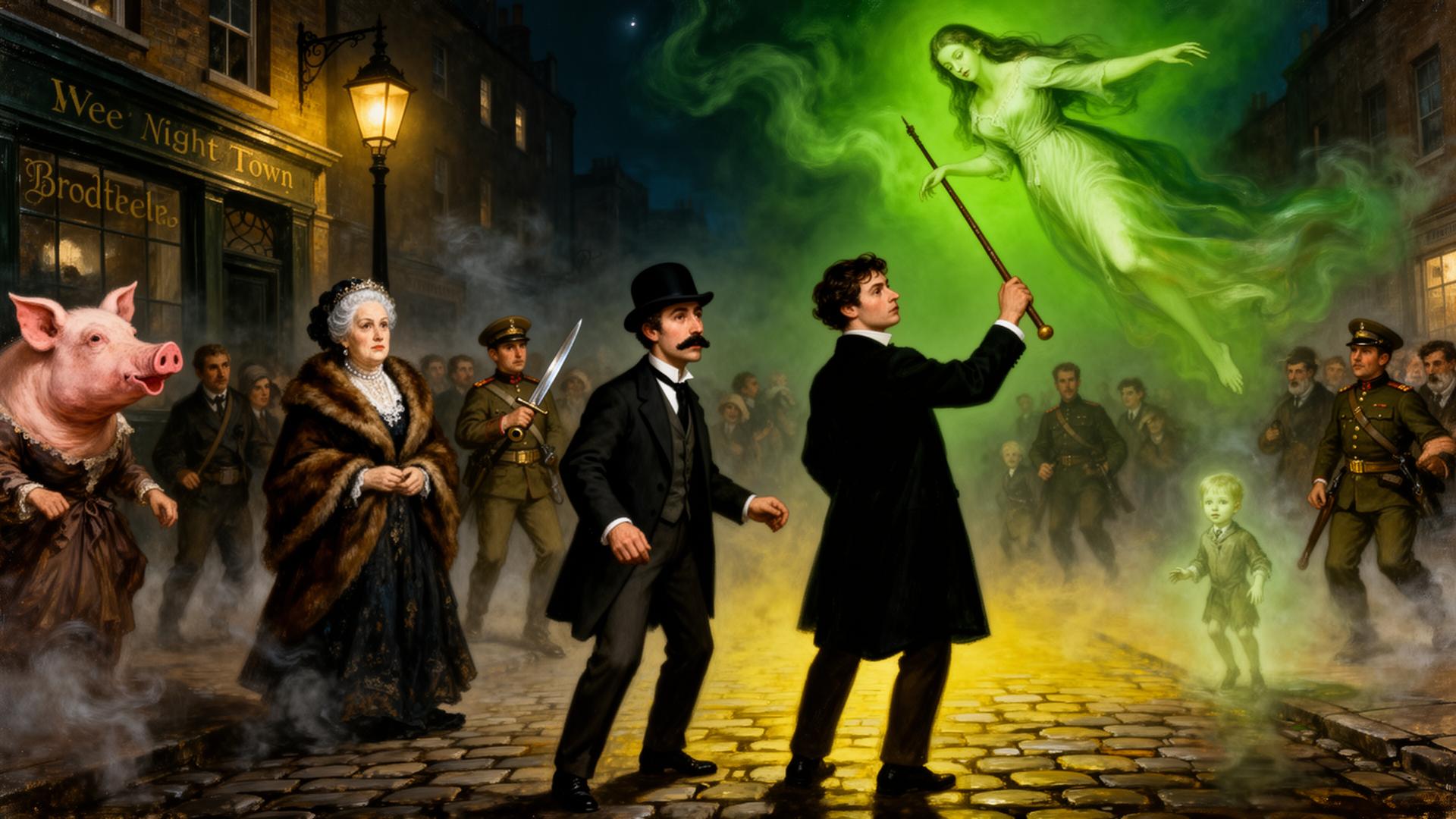
Painterly hallucinatory midnight scene in Dublin's Nighttown: a gas-lit cobbled street outside a brothel, fog and grotesque dream-figures, Bloom in a bowler hat looking bewildered, Stephen Dedalus raising an ashplant stick toward a green spectre of his dead mother.
Nighttown · Mrs Cohen's · Midnight
Playbill — Hallucinations in One Act
A Trial · A Coronation · A Black Mass · A Resurrection
Ep. XV · 17 vi 1904
Episode XV · Circe · The Unconscious as Stage

Circe: Bloom Walks Through the Brothel of Himself.

Episode 15 is the climax of Ulysses — a 180-page play-script in which Homer's witch becomes a Dublin madam, men become hallucinated versions of themselves, a potato in a pocket becomes the magic herb moly, and a father, at the end, finally sees the son he lost.

"(He lifts his ashplant high with both hands and smashes the chandelier.) Nothung!"
Ulysses, Episode 15
L
Leopold Bloom
Protective guest
B
Bella Cohen
Madam of the house
O
Odysseus
Sword drawn on Circe
C
Circe
Witch with the wand
Plain-English mode
Scroll to begin
§1 · Why "Circe"?

A brothel, a potato, a play.

In Book 10 of the Odyssey, the witch Circe turns Odysseus' men into pigs in her hall. Hermes gives Odysseus the magical herb moly, which makes him immune; he draws his sword, forces Circe to restore his men, and stays a year with her.

Joyce moves the hall into a Dublin brothel and the magic into the unconscious. The men do not literally become pigs — they hallucinate themselves into a hundred buried forms, and the chapter is written as a 180-page play-script so that those hallucinations can walk onstage beside the cobblestones. Bloom is protected by a potato. At the very end, the chapter restores his lost son to him for a single visionary page.

Circe's wand becomes a kitchen tuber; her hall becomes the Dublin night.

  1. c. 8th c. BCE
    Homer's Odyssey
    Circe turns Odysseus' men into swine; Hermes gives him moly
  2. 1904
    Monto / Nighttown
    Dublin's red-light district, one of the largest in Europe
  3. 17 June 1904, ~midnight
    Bella Cohen's brothel
    Bloom follows Stephen; the unconscious of both walks onstage
  4. 1920–21
    Drafted in Paris
    Joyce wrote the chapter nine times and called it the hardest
  5. 1922
    Publication
    Ulysses appears in Paris
§2 · Odyssey Primer

Circe in The Odyssey — in brief.

After the cannibal Laestrygonians have destroyed eleven of his twelve ships, Odysseus lands on Aeaea, the island of the witch Circe. He sends half his crew under Eurylochus to scout. Circe feeds them drugged food and turns them into pigs in a sty.

Odysseus sets out to save them. Hermes meets him on the path with the herb moly, which makes Circe's drugs powerless. Odysseus drinks, draws his sword, forces her to restore his men, and ends up sharing her bed for a year before sailing on.

Joyce takes this story — a magical hall in which men's hidden natures surface as another shape — and turns it into a single hallucinatory night in a Dublin brothel, with the unconscious as the magic.

§3 · How Homer becomes Dublin

Six transformations, from Aeaea to Nighttown.

Homer
Circe, the witch in her hall
Joyce
Bella Cohen, madam of the brothel

Homer's Circe is a goddess with a wand who literally turns men into pigs. Joyce's Bella is a fat, formidable Dublin madam whose 'magic' is the institution she runs — the brothel as the modern equivalent of a sorceress's hall. She never actually transforms anyone; the transformations happen inside the men who walk through her door, and Joyce stages them as hallucinations.

BELLO: (His heavy cheekchops sagging.) Adorer of the adulterous rump!
Ulysses, Episode 15
Bellametamorphosisbrothel
§4 · Who's Who

Homeric counterparts in Episode 15.

Circe stages the Dublin brothel as the modern hall of metamorphosis — every guilt and longing of the day puts on a costume.

UlyssesOdyssey counterpartNote
Leopold BloomOdysseus, immune via molyProtected by his pocket potato; rescues Stephen at the end
Bella / Bello CohenCirce / a male-coded enchantressMadam whose brothel is the chapter's transformation chamber
The pocket potatoMolyFolk amulet from Bloom's mother — the chapter's literal magic
Stephen DedalusA sailor who half-transformsDrinks, hallucinates his mother, smashes the lamp, runs out
May Dedalus (vision)Anticleia in the underworldStephen's dead mother rising green-faced from the floor
Zoe, Florry, KittyCirce's handmaidsThe brothel's three young women — minor enchantresses
Rudy (vision)Hermes' restorationBloom's lost son appearing at the chapter's end as an 11-year-old
Linati Schema (1920)

Scene: The Brothel. Art: Magic. Symbol: Whore. Technique: Hallucination.

Gilbert Schema (1921)

Organ: locomotor apparatus. Colour: none. Hour: midnight.

Homeric correspondences

Circe → Bella. Moly → potato. Swine → hallucinated selves.

§5 · Key themes

Ten threads through the night of magic.

Hallucination

The chapter's technique — psyche as stage direction.

Moly

Bloom's pocket potato as folk-protection against magic.

Father-son

Bloom physically rescues Stephen — the bond completes.

Guilt

The day's small sins come back as theatrical accusers.

Gender

Bello dominates a feminised Bloom — Joyce on identity.

Rudy

The vision of the lost son is the novel's emotional pivot.

Theatre

180 pages of stage directions; reality and unreality co-cast.

Nighttown

Real Dublin Monto — Joyce's most documented setting.

Non serviam

Stephen's refusal is the chapter's loudest single line.

Mercy

Bloom protecting the unconscious Stephen is its quietest.

§6 · Quotations & close reading

Homer beside Joyce.

Homer

"She struck them with her wand and shut them in the sties. They had the heads and grunting voices of swine, and their bodies were bristled, but their minds were unchanged — even as they had been before."

Odyssey, Book X

Joyce

"BELLO: (...His heavy cheekchops sagging.) Adorer of the adulterous rump! On hands and knees! … Down!"

Ulysses, Episode 15 (Bloom's hallucination)

Why this matters

Homer's swine retain a human mind inside an animal body; Joyce's Bloom retains a human body inside an animal hallucinated self. Both are pictures of the gap between what we are and what we feel ourselves to be.

Homer

"Hermes gave me the herb, drawing it from the earth, and showed me its nature. The root was black, but its flower was white as milk. Moly the gods call it. It is hard for mortal men to dig."

Odyssey, Book X

Joyce

"BLOOM: I have it somewhere. … (He retrieves the potato.) Talisman. Heirloom."

Ulysses, Episode 15

Why this matters

Homer's moly is a divine gift; Joyce's is a kitchen tuber kept for sentimental reasons. The chapter's joke is also its theology: in a modern city the things that actually protect you are the small heirlooms you happen to be carrying.

Homer

"But Hermes touched them with his wand, and the bristles fell from their bodies … and they became men again, younger than they had been before, and taller, and fairer to look upon."

Odyssey, Book X

Joyce

"(Against the dark wall a figure appears slowly, a fairy boy of eleven, a changeling, kidnapped, dressed in an Eton suit … He reads from right to left, kissing the page.) BLOOM: (Wonderstruck, calls inaudibly.) Rudy!"

Ulysses, Episode 15 (closing)

Why this matters

Hermes restores the swine to men; Joyce restores Bloom's dead son for a single page. The chapter's whole grotesque machinery has been quietly working toward this image — the modern equivalent of a Homeric resurrection is a private vision in a back alley.

§7 · Modernity vs Epic

A witch's hall, rewritten as a brothel.

Homer

A goddess, a drug, a sty

A literal witch literally transforms men into animals. Magic is external and divine; the protection is an external, divine herb. The hero stands up to the witch and shares her bed.

Joyce

A madam, a pocket potato, a play

A Dublin madam runs a brothel; the transformations are internal hallucinations rendered as stage directions. Protection is a kitchen tuber, the hero rescues a young man who is not his son, and the witch is paid in cash.

Joyce keeps the magic and locates it where modernity actually places it: in the unconscious, the city street, and the small objects we carry without knowing why.

§8 · Why this episode matters

The climax — and the moment Bloom finally has a son again.

Circe is the place toward which the whole novel has been moving. Every guilt, every fantasy, every small humiliation of the day surfaces here in costume — and is paid for by the chapter's grotesque theatre. Joyce wrote it nine times and considered it the hardest chapter in the book.

And under the noise it does something quietly decisive. Bloom finally — physically — protects Stephen, lifts him out of the gutter when a soldier knocks him down, and is granted, by the chapter, a vision of his lost son Rudy. The substitute paternity that has been building since Telemachus is, in Circe, simply accomplished.

The brothel of the unconscious turns into the place where a lost father finds, for a single page, a son.

§9 · FAQ

Quick answers.

  • Joyce maps Episode 15 onto Book 10 of the Odyssey, where the witch Circe turns Odysseus' men into swine in her hall. The Joycean equivalent is Bella Cohen, the madam of a brothel in Nighttown (Dublin's red-light district of Monto), whose 'magic' is the brothel itself — the place where men's repressed desires take on flesh as hallucinations and 'transform' them into pigs of their own buried selves.