Episode III
Proteus
Ineluctable modality of the visible.
11:00 AM, Sandymount Strand. Style: Interior monologue (male).
Back to your filtered episode list
Summary
Stephen walks the beach, lost in dense philosophical thought about perception, memory, and shape-shifting. A famously interior chapter.
- 1
Closing the eyes
Stephen tests the limits of sight, walking with his eyes shut to feel the world by sound. The chapter is almost entirely inside his head.
- 2
Aunt Sara's house
He imagines, then declines, a visit to his uncle Richie Goulding's house — a quiet picture of family failure.
- 3
Paris memories
He remembers his student months in Paris: cheap cafés, telegrams, his mother's death pulling him home, the cheap-looking artist he was trying to be.
- 4
Cocklepickers and a dog
A pair of cockle-pickers and their dog cross the strand. The dog sniffs at a drowned corpse Stephen has been told about. He writes a few lines of verse on a scrap of Deasy's letter.
- 5
The leaving
He pisses against a rock, picks a scab, glances over his shoulder — and on that small private gesture the chapter ends.
Gabler lines 3.1–505
Proteus's close reading map just grew — three new sections added 24th September.
How Proteus unfolds, scene by scene
This is a map, not a recap. Proteus has almost no plot: Stephen walks along Sandymount Strand for roughly an hour and thinks. What changes is the mind, not the scenery, so the map tracks the movement from abstract theory, through memory and shame, to a body on a beach that finally looks outward.
Stephen tests how the world reaches him: first by sight, then by sound, then by touch, walking with his eyes shut to prove the world is still there.
1. The ineluctable modality of the visible
lines 1–37Stephen names what he is doing — reading the signatures of things — and closes his eyes to test whether the world survives without his looking.
Why it matters:The episode's method is stated in its first paragraph: perception, not narration, is the subject.
Notice:The crunch of shells under his boots becomes proof of existence. Aristotle is being tested with footwear.
2. The midwives and the navelcord
lines 29–72Two women come down the steps to the strand and Stephen spins them into midwives, a bag, and a cord running back to Eve.
Why it matters:Stephen's mind cannot leave anything ordinary alone; every sight is converted into descent, origin and guilt.
Notice:“The cords of all link back.” Paternity and origin will haunt him until Bloom appears.
3. The Goulding visit he does not make
lines 73–164Stephen imagines calling on his aunt Sara's house, hears his father's mockery of the Gouldings, and walks past the turning.
Why it matters:The first of the episode's refusals: family is imagined vividly and avoided physically.
Memory takes over: the failed Paris exile, the heresiarchs, Kevin Egan, and then the drowned man the boatmen are waiting for.
4. Paris remembered
lines 165–264Stephen relives his student months in Paris — the telegram calling him home, the cheap meals, the posturing.
Why it matters:The exile he wanted is already a failure he has returned from; ambition and embarrassment are the same memory.
Notice:“Mother dying come home father.” The telegram that ended Paris also begins his guilt.
5. Kevin Egan, the wild goose
lines 216–264Stephen recalls the exiled Fenian Egan, forgotten in Paris by the country he fought for.
Why it matters:Egan is the future Stephen fears: exile that ends in irrelevance rather than art.
6. The drowned man
lines 265–399Stephen thinks of the body the boatmen expect to surface, of a rescue he could not make, and of water as something he fears.
Why it matters:Death by water sets up the drowning imagery Bloom will meet from the other side, and exposes Stephen's physical cowardice.
Compared with Homer · Menelaus wrestles Proteus
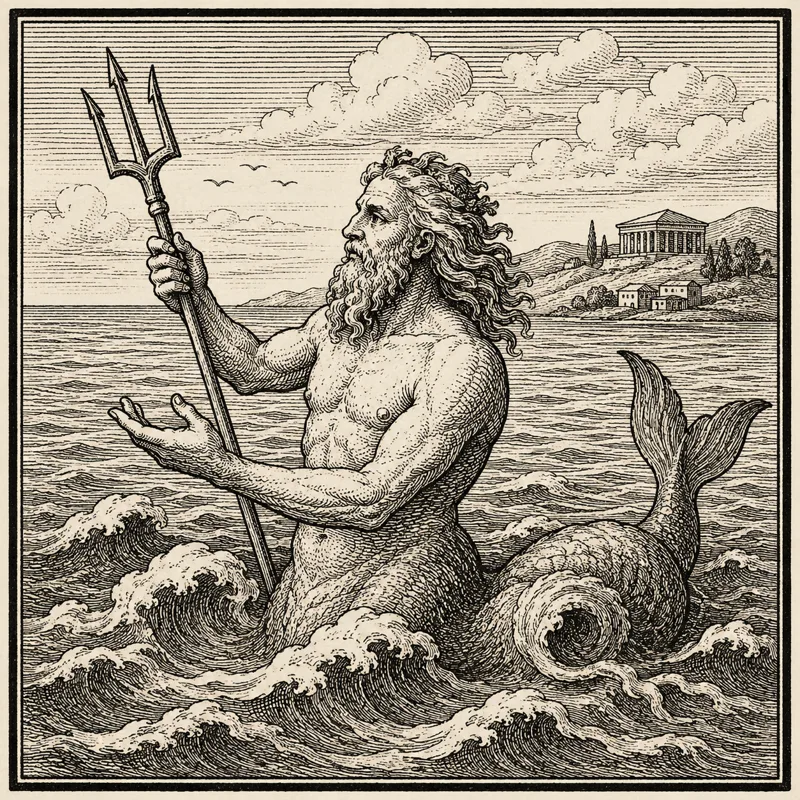
In Odyssey Book IV, Menelaus pins the shape-shifting sea-god through every transformation until Proteus yields the truth. Stephen attempts the same hold on a world that will not stop changing — tides, sand, corpses, language itself. Where Menelaus wins an answer, Stephen gets only more metamorphosis, which is the joke and the point.
The cockle-pickers pass, Stephen scribbles a poem, relieves his body, and finally looks up at a ship.
7. The cockle-pickers and the dog
lines 400–498A man, a woman and a live dog cross the strand; the dog sniffs a dead dog and Stephen watches with envy and distaste.
Why it matters:The living animal does effortlessly what Stephen cannot: meet the world with its body instead of a theory.
Notice:Stephen remembers he is afraid of dogs. He is afraid of nearly every physical thing in this episode.
8. The vampire poem
lines 397–443Stephen tears a corner from Deasy's letter and writes four lines about a mouth to a mouth's kiss.
Why it matters:His only act of creation all morning is scrap-sized and derivative, and he knows it.
9. Snot, teeth, and the threemasted ship
lines 444–endStephen urinates, picks his nose, checks whether anyone saw him, and looks over his shoulder at a silent ship coming home.
Why it matters:The episode ends by leaving the mind for the body and then for the horizon — the first outward look of the book.
Notice:“Rere regardant.” The very last gesture is a turn of the head, away from himself.
The shape underneath
Proteus runs theory → memory → shame → body → outward glance. Everything in it changes form: sand into language, women into midwives, a dog into a hare into a corpse, a letter into a poem. The episode ends the Telemachiad by leaving Stephen alone, unfed, unhoused and looking seaward, just before the book jumps to a man frying a kidney. See the Homeric parallel below for how the shape-shifter myth organises the whole hour.
Line by Line analysis
Read every paragraph of Proteus with plain-English translation and scholarly notes.
Ineluctable modality of the visible: at least that if no more, thought through my eyes.
Stephen closed his eyes to hear his boots crush crackling wrack and shells.
Won't you come to Sandymount, Madeline the mare?
Reading Room Archive
Enter the Reading RoomIn modern prose
Late morning, alone on Sandymount Strand with an hour to kill. Nothing external happens here. Stephen walks along the tideline and the chapter is simply the inside of his head, recorded almost in real time. He plays with the philosophical idea that we only know the world through our senses, tests it by closing his eyes and listening to his own footsteps, and slides off into memory: his student days in Paris pretending to be a bohemian, his uncle's grim flat, his mother's death, a drowned man whose corpse is expected to wash up nearby, the rhythm of the sea, the way language slips between meanings. He picks his nose, has a wee behind a rock, scribbles four lines of poetry on a scrap torn from Deasy's letter. The chapter is a stress-test for the reader — this is what Joyce's stream-of-consciousness really feels like at full strength — but it's also about a young man trying to think his way out of grief and failure with only his own clever brain for company, and discovering, slightly, that it isn't enough. He's lonely. The book is about to introduce him to someone who, without ever quite saying so, will offer him a way out.
What to notice
Why is Proteus difficult?
Because Joyce gives you Stephen's mind with no handrails. The episode is dense with allusions — to Aristotle, Berkeley, Dante, scripture, and several languages — and there's almost no external action to orient you. This is interior monologue at full intensity, which is also why it's a touchstone in any account of why Ulysses is difficult.
What should you focus on while reading it?
- Read for mood and rhythm.
- Hold the recurring threads. Perception, change, his mother, his ambitions — these return.
- Let the allusions go. Catch what you can; nobody catches all of it.
- Reread the opening lines. "Ineluctable modality of the visible" rewards a second pass.
Context and parallels
The Linati and Gilbert schemas
- Scene
- The Strand
- Hour
- 11:00 AM
- Organ
- —
- Art
- Philology
- Colour
- Green
- Symbol
- Tide
- Technic
- Monologue (male)
- Correspondence
- Proteus
Common questions
- What happens in Proteus, the third episode of Ulysses?
- In Proteus, Stephen Dedalus walks alone along Sandymount Strand at about 11 a.m., and almost nothing 'happens' externally. The episode is his unbroken interior monologue — a flow of philosophy, memory, and perception as he thinks about reality, his family, and his future.
- Why is Proteus so difficult?
- Proteus is hard because it's almost pure interior monologue, packed with allusions to philosophy, theology, and languages, with little external action to anchor you. Joyce removes the usual signposts and asks you to follow Stephen's mind directly.
- What should I focus on while reading Proteus?
- Don't try to decode every line. Follow the rhythm and the recurring concerns — perception, change, his mother's death, his ambitions — and let the difficult references wash past. The feeling and movement matter more than full comprehension.
- Why is the episode called Proteus?
- Proteus is the shape-shifting sea god of the Odyssey, whom you must hold fast as he changes form. The episode is about flux — the way matter, perception, and identity keep transforming — mirrored in Stephen's restless, shifting thoughts on the shore.
Project Gutenberg, public domain.
Further reading
Guides, essays and Daily Companion days that go further into Proteus.
- Beginner's guide to UlyssesWhere to start, and how to keep going.
- How to read UlyssesPractical ways through the book's hardest stretches.
- All 18 episode summariesSee where this episode sits in the whole day.
- Daily Companion, Day 11: Stephen shuts his eyes on the strand and thinks about seeingAlone on Sandymount Strand, killing time before a meeting, Stephen walks and thinks — and the prose follows his mind without translation.
- Daily Companion, Day 13: Stephen remembers Paris, and the family he's avoidingHis thoughts drift to his recent stint in Paris — borrowed glamour, late nights, telegrams, and the news of his mother's illness that called him home.
- Daily Companion, Day 15: Stephen writes a scrap of poetry and sees a silent shipStephen tears a corner from Deasy's letter and scribbles a few lines of verse, studies his own body and bad teeth, relieves himself among the rocks, and — turning to leave — looks back to see a tall ship coming silently up the bay.
- Who's who in UlyssesLeopold Bloom, Stephen Dedalus, and the cast of Dublin.
- Themes in UlyssesThe ideas that run beneath every episode.
- Dublin locations in UlyssesWhere Sandymount Strand sits on Bloom's day.